An Overview of Floating Rooftop Dunnage Design – Part I
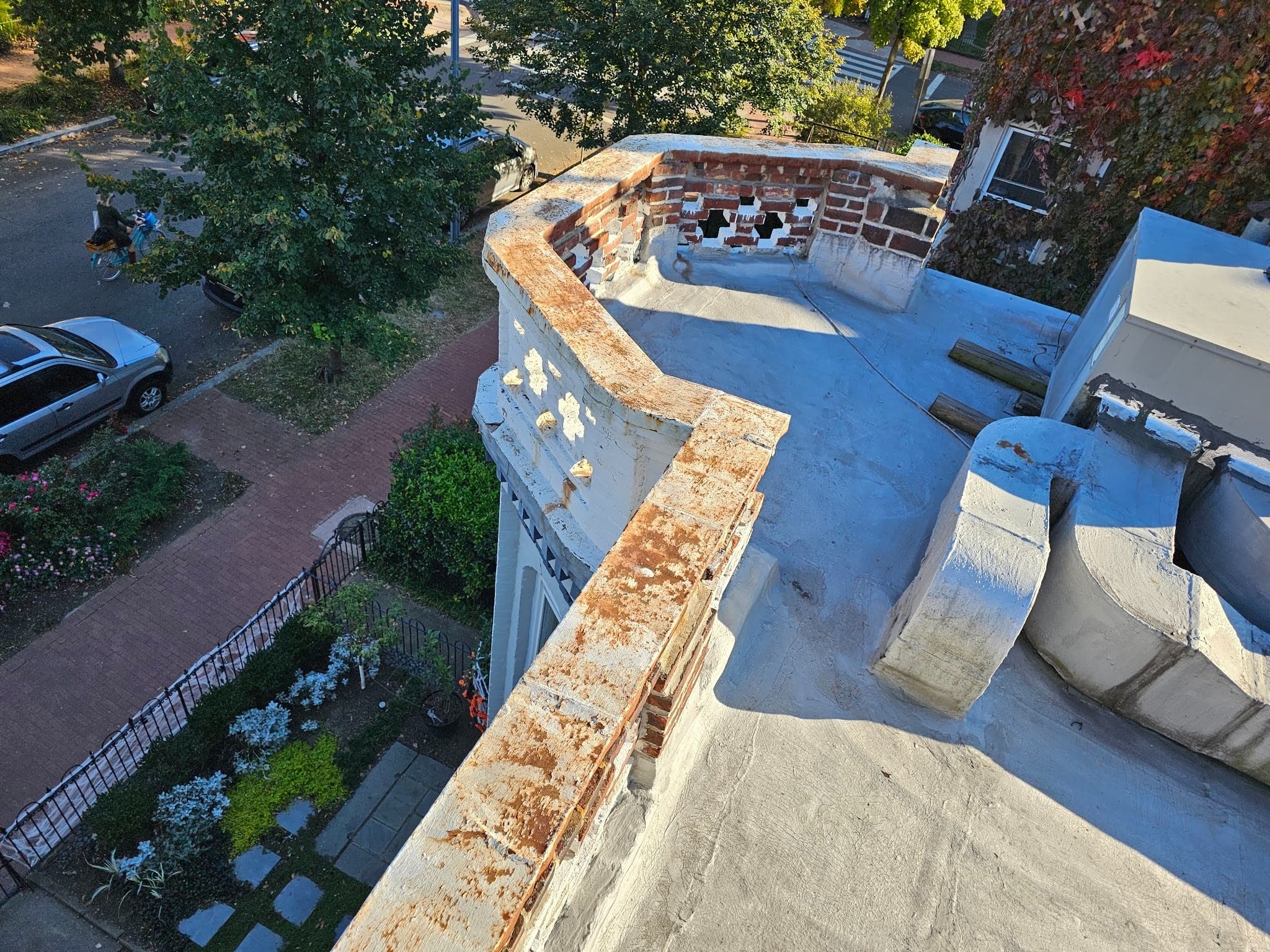
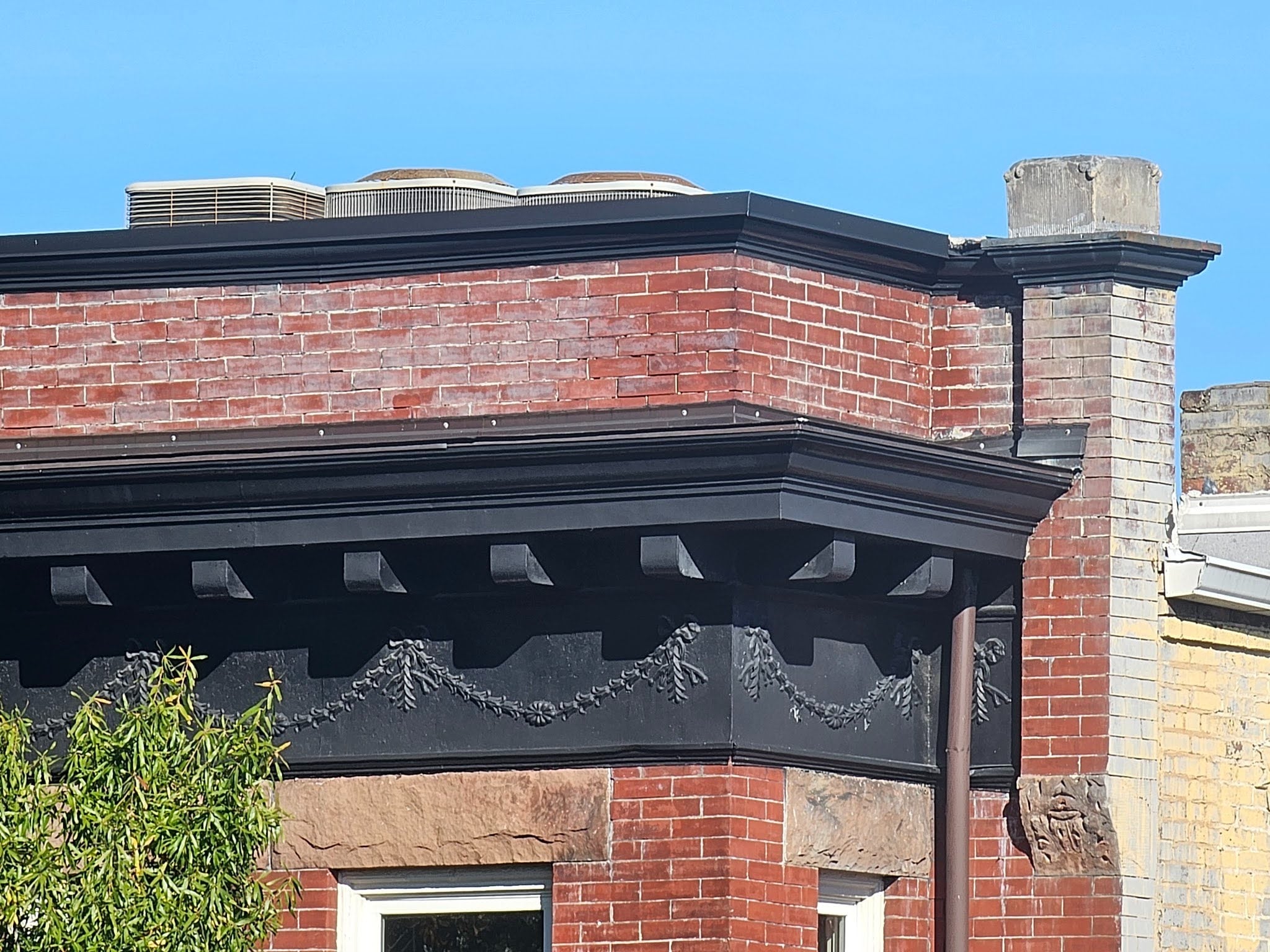
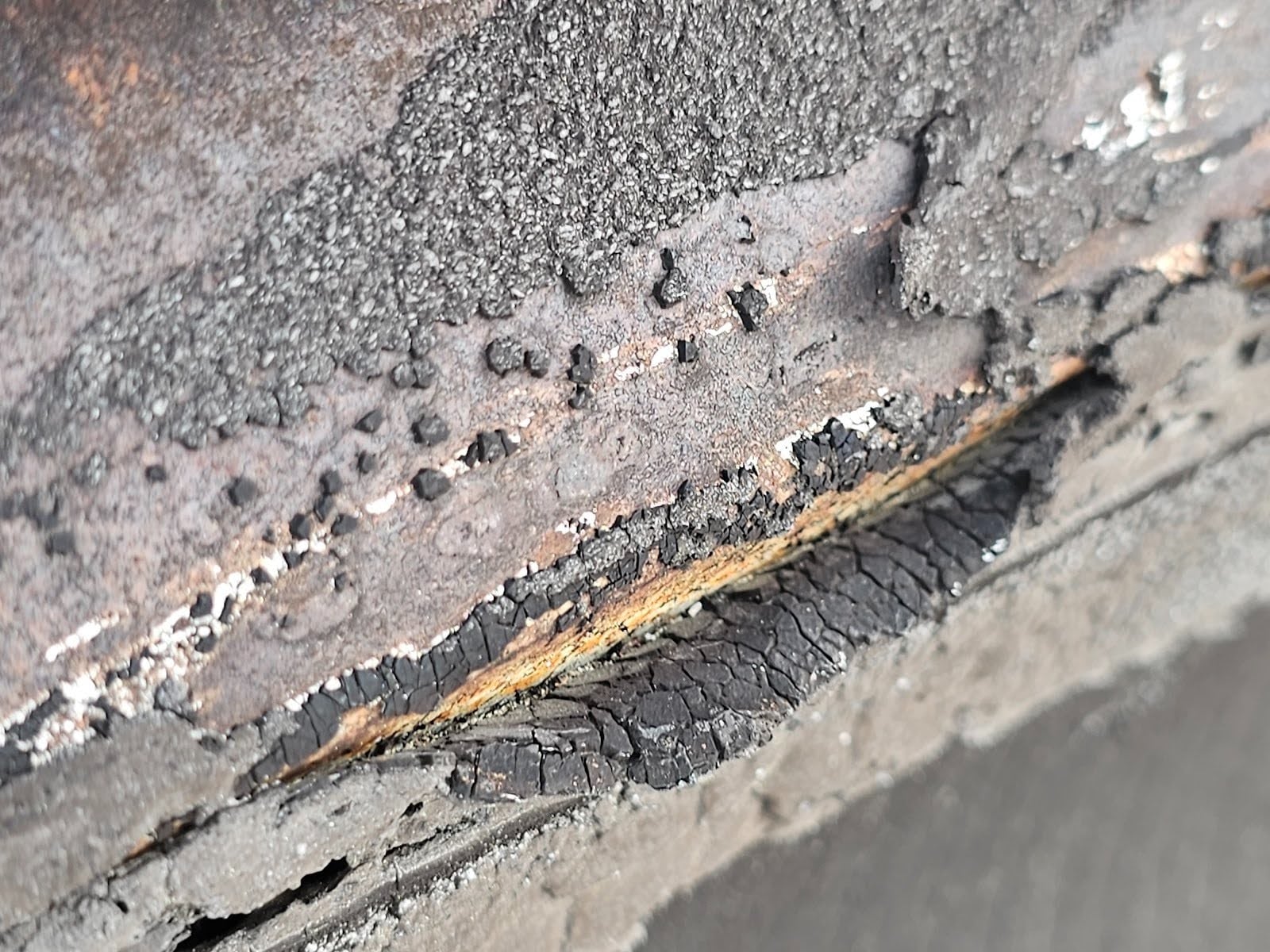
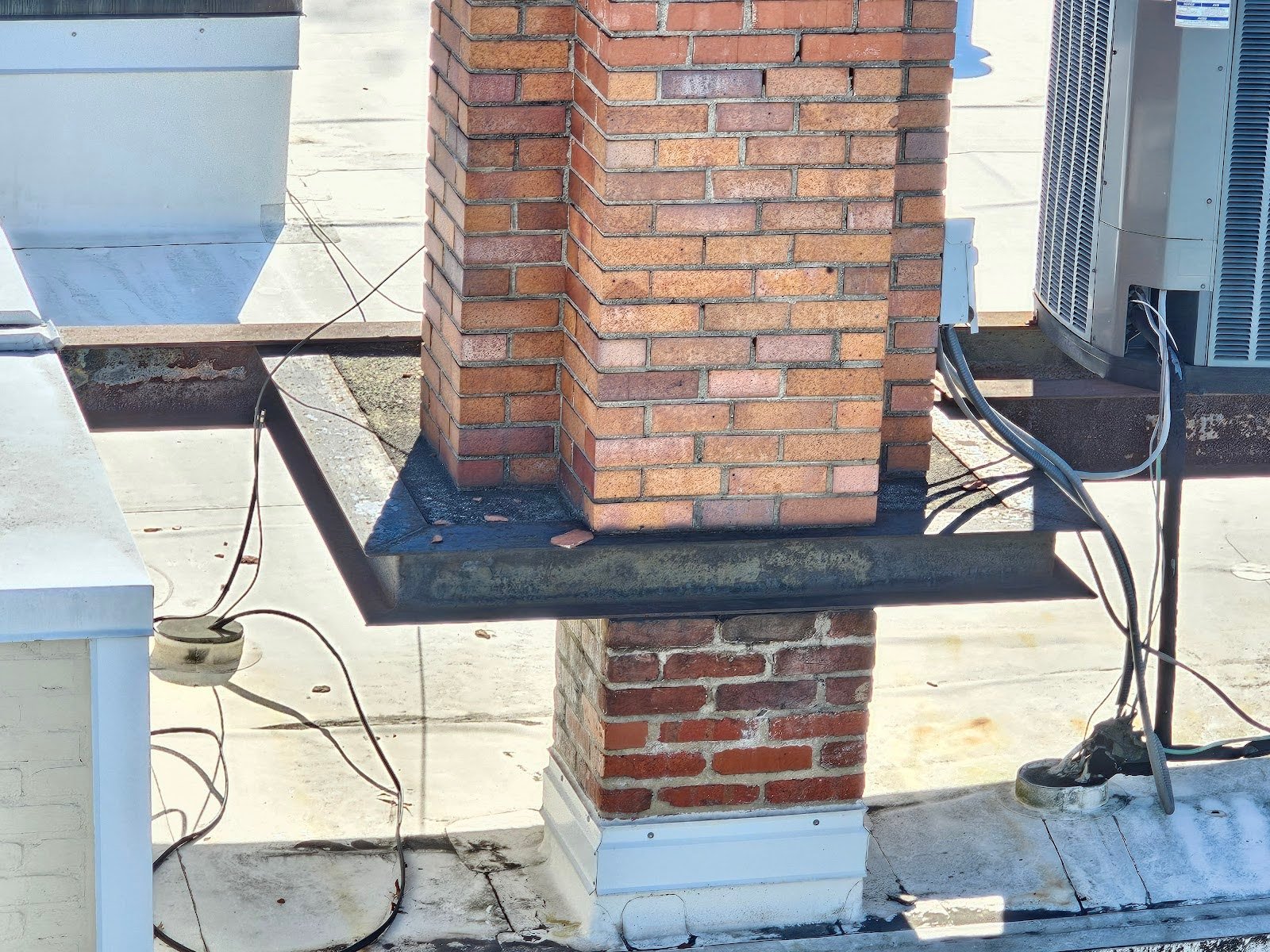
A lot of details and construction are custom built so they might be kind of unique, one of a kind. Unique details like this or prolific throughout Washington DC on all types of different building systems. Recently, we were going to a nearby roof and we saw something we had not seen before. We’ve seen other systems like this but not quite exactly the same. Pictures below show examples of a rooftop AC steel beam dunnage system.
Dunnage systems are material assemblies put together to support mechanical equipment or all types of different equipment on rooftops. In this case, it’s not the same as a typical dunnage system because it’s not sitting directly on the roof and is really built into the parapet walls like a more common I-beam pair used to mount AC condenser units on typical row homes in Washington DC.
That type of assembly is very common. This is different though because in this case there’s only one beam installed and for stability, because a single beam lacks the stability of two independent beams unified together where they are supporting a mechanical equipment unit. This one though instead has an extending steel beam attachment that wraps around an adjacent chimney to use the chimney for support but simultaneously also stabilizes an extension of the chimney itself. We don’t have a full explanation for why it’s like this because the original builders are no longer around for questioning.
It’s a weird looking configuration, particularly when you think about the structural elements. This isn’t a location where people normally wouldn’t see it. It’s up on top of a roof where we only had the vantage point of seeing it clearly because we were working on an adjacent roof nearby.
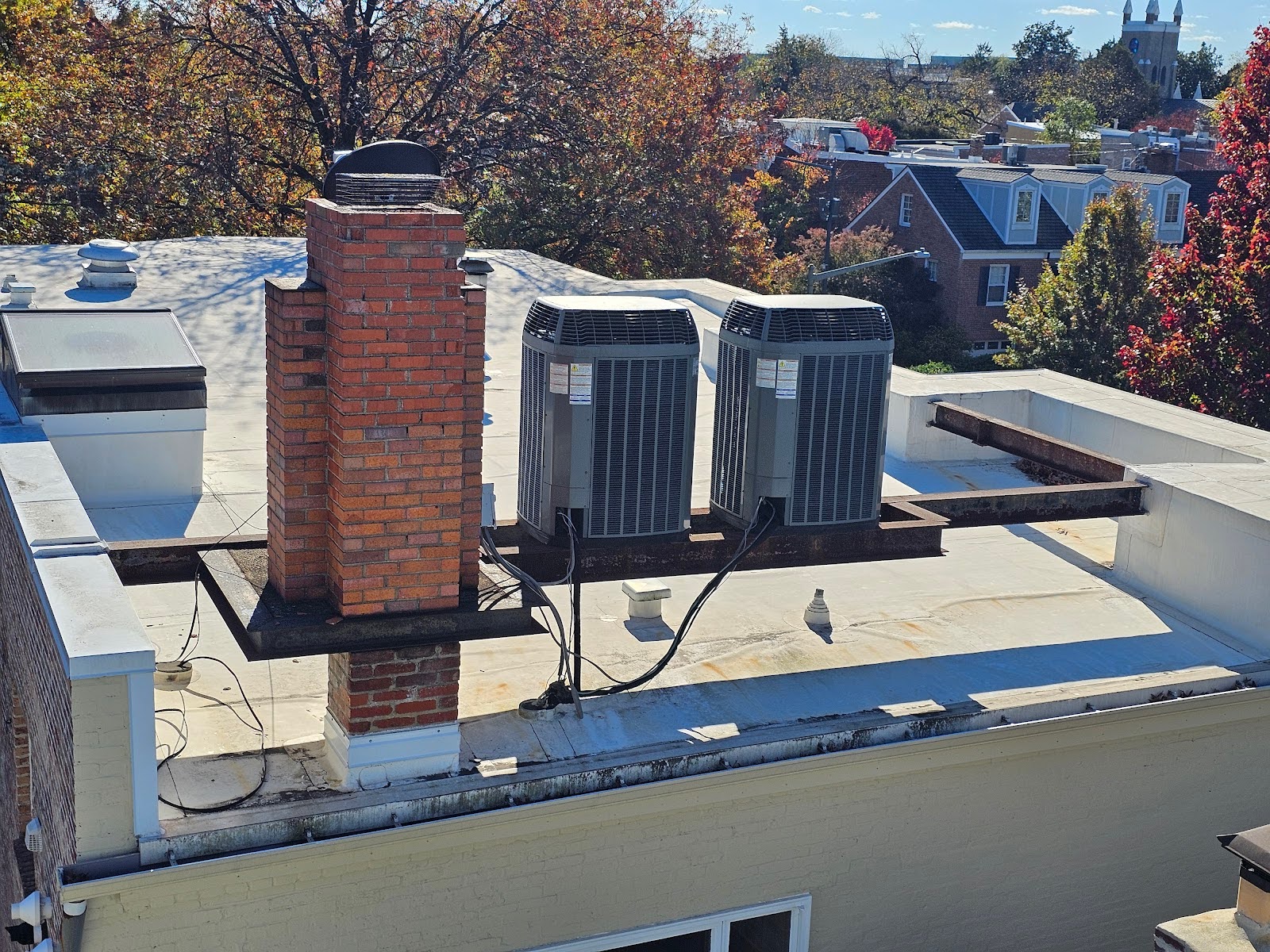
The problem with this type of assembly is that it lacks proper torsion resistance. A setup with two I-beams inherently has torsion resistance because the load can be spanned between both beams. It’s simple if you imagine a table. If a table has one leg at each end, it’s not stable. That kind of describes how this is set up, except in the middle they’ve tied it to the chimney which they’re using to resist torsion. That is a weak connection for several reasons.
Firstly, the chimney is built of individual courses of brick. Those courses lack tensile resistance. That’s one of the most important and inherent weak points in masonry. Here though, it’s a tensile resistance that the chimney is being used to provide. That’s something that a chimney is not good at, naturally.
Masonry is inherently weak in tensile strength because it is built as a composite. In other words it’s made of individual brick units, these are together assembling a non-homogenous element. The word non homogeneous is not used often in construction or engineering, but it basically means that the individual elements are still separated, even when they’re bound by mortar in this case, in terms of masonry. Most people only come across the word homogeneous when they’re reading a label on a bottle of milk. But it’s a good analogy.
Essentially when milk has been homogenized, the individual fat particles have been evenly distributed so that they’re consistent across the entirety of the liquid. Here it’s a solid, of course, but the principle holds consistent. In the case of steel, it has a very high tensile strength, because its strength axis is continuous across the entirety of that single element. It’s not a compilation of many individual elements hodgepodged together in a brittle form. The analogy is very abstract, but understanding the non-homogeneous nature of masonry helps understand the difference between tensile strength and compressive strength.
Masonry is inherently strong in compressive resistance. That means that masonry naturally has the ability to resist being compressed. You can literally load masonry with up to a thousand pounds per square inch of surface before it will break. It stays stable under massive compressive loads. Here though, instead, they’re using the chimney for torsion resistance, and when you look at torsion resistance, it’s putting the individual courses of the chimney into a tensile stress. The chimney just isn’t made for that. This configuration makes it highly vulnerable to forces that pull it apart, as opposed to compressive forces which it resists well.
In this coming week, we’ll look at other pictures of the same installation but discuss some of the other material components and the assemblies.
We provide this information here on our blog, and our website, to help our customers and future clients, and we recommend every building owner in DC who values the longevity of their roof (and their investments) and building use a contractor who values the simple and important principles of proper roof construction like Dupont Roofing DC. Our company specializes in flat roofing in Washington DC and we’re happy to help building owners of almost all types.
Learn more about our company and the proper techniques of working with roofing on historic buildings in Washington DC here on our blog at DupontRoofingDC.com, and you can call us at (202) 840-8698 and email us at dupontroofingdc@gmail.com. We are happy to help and at least talk through options.