Essential Rooftop Lightning Protection Systems in Part II
This past week, we looked at a type of lightning strike prevention or protection on a commercial flat roof. Many buildings are built similarly, but unlike the thousands of row homes across the historic parts of Washington DC, these commercial buildings generally have unique elements. A lot of these details are not repeated from one building to the next. Even among the individual row homes that have, after 100 years have gone by, many things have been modified uniquely at almost every rooftop. There are multitude of different types of roof systems and permutations or combinations of pairings of types of roof elements in their unique assemblies together.
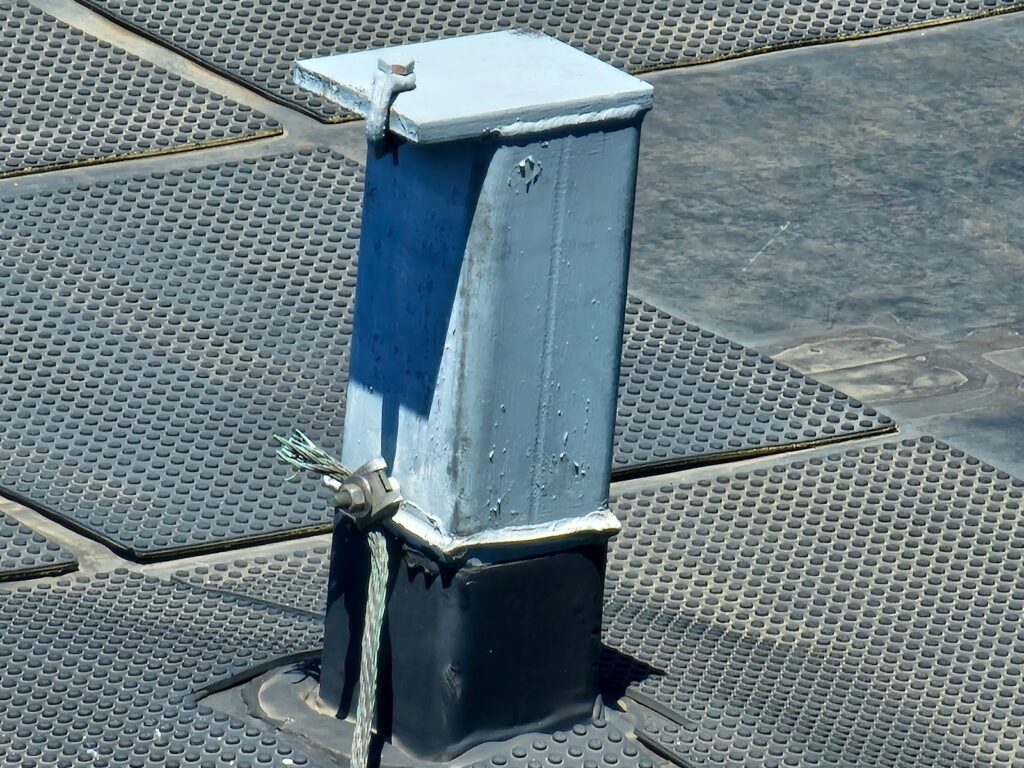
The picture below shows a galvanized tube steel roof hook from the commercial roof we looked at this past week. This particular type of element is above the rooftop and has been terminated or sealed to the roof system with a type of field fabricated flashing, like a target patch. You can see the copper cabling and the clamp which connects that cable to the base of this particular device.
A significantly sized u-bolt is attached to the welded plate at the top of this tube steel. That bolt works like a hook to provide a place where window cleaners or anyone else that needs to be secured, from a safety perspective, can tie to something solid above the rooftop.
It is likely rated to support more than a sufficient load needed for both bosun chairs and even scaffolds. These devices are used to let people access the face of the building without having to build scaffolding all the way from the ground. To reach the facades, at points above 5 or 6 stories, becomes very difficult, because it’s complicated to build scaffolding all the way up to high points on a facade. Instead, it could be much easier to bring the individual materials for bosun chairs or swing stage type scaffolds up through a building piece by piece, then assemble the elements on top of the roof, and then hang down the rooftop from connection points like this.
From a life-cycle cost perspective, this makes the management of a building maintenance program much less expensive. Not having these types of hooks means that alternative methods have to be used by each contractor who works on the building facade in the future. Even if the individual contractors are pricing things cheaply, they cannot do excessively higher amounts of work for a lower cost so they have to pass that cost onto the building owner. By building provisions for access into the rooftop structure, it saves the building owner a significant amount of money again and again throughout the life of the building.
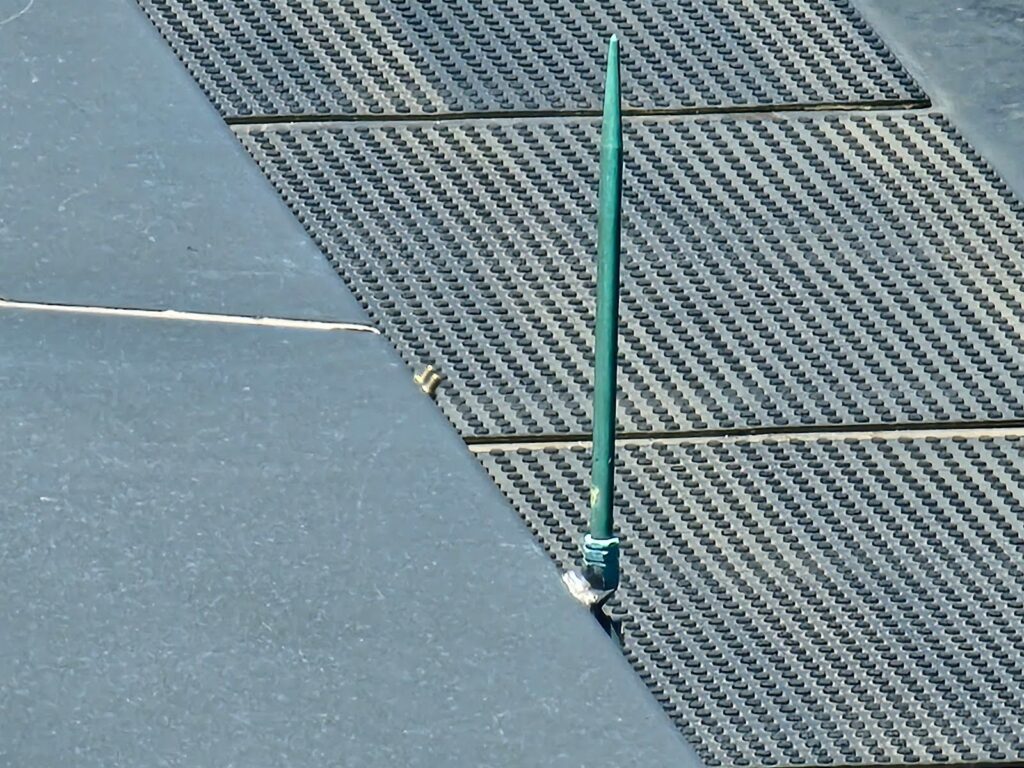
We looked at these spiky lighting catchers, colloquially referred to as lightning rods sometimes, but technically referred to as air terminals, this past week. You can see the blue color of these air terminals in the picture below. They are blue, not as a design choice, but as a material characteristic. They are made from copper which has extremely high electrical conductivity. It helps for them to have extremely high electrical conductivity because they’re intended to not necessarily attract but become a path of least resistance for the flow of potentially dangerous electricity.
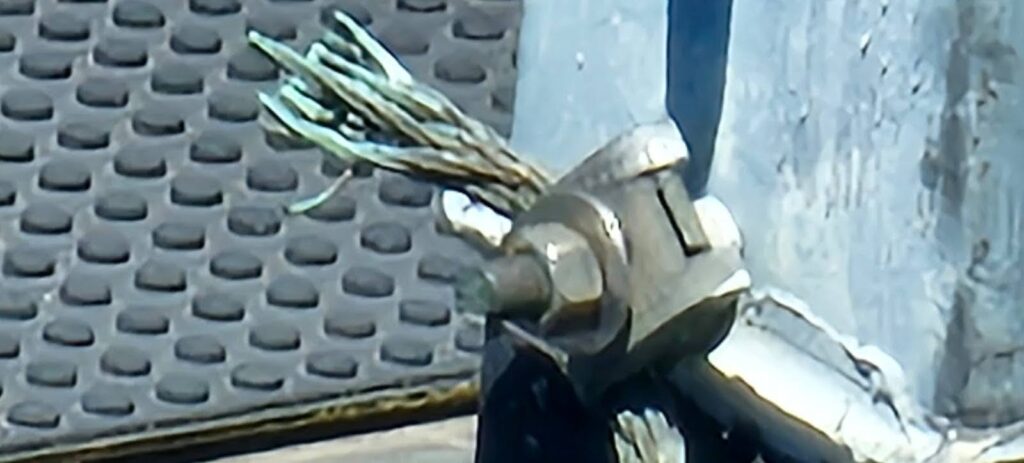
The picture below shows a frayed portion of the braided copper conductors where clamps to the rooftop connection hooks. These clamps essentially put the cabling into an extremely high pressure type connection. That tight type of connection is important for bonding. Essentially, the cable has to have good connectivity to the other types of metal works there on the rooftop. If the wire is loose or not well connected, tightly, a lightning strike may diffuse outwards to other elements, and or architecture dangerously instead of following this cabling is a path of least resistance.
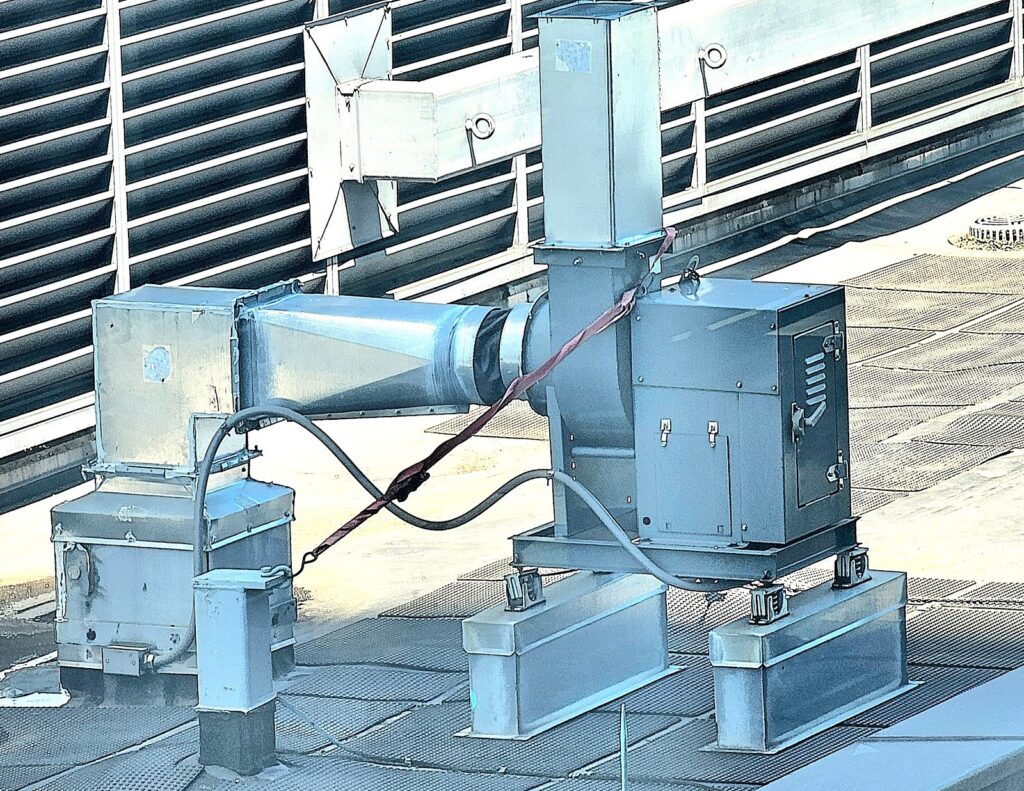
There are many different types of rooftop mechanical units, installed to service parts the building interior. We find these on all different types of roof systems. The particular one here shown in the picture below is a centrifugal exhaust system. This type of HVAC equipment could be used for exhausting particular spaces in the building or for stairway exhaust or even stairway press systems. In some cases during the engagement of a fire alarm system, a stairway will be pressurized so that air escapes outward when doors are opened or through the cracks around or under a door instead of being sucked inward.
This helps contain the spread of the fire. Essentially, it may limit the amount that a fire can travel between different levels, if the stairway does not become a pathway for the fire to flow.
We provide this information here on our blog, and our website, to help our customers and future clients, and we recommend every building owner in DC who values the longevity of their roof (and their investments) and building use a contractor who values the simple and important principles of proper roof construction like Dupont Roofing DC.
Our company specializes in flat roofing here in Washington DC and we’re happy to help building owners of almost all types. Learn more about our company and the proper techniques of working with roofing on historic buildings in Washington DC here on our blog at DupontRoofingDC.com, and you can call us at (202) 840-8698 and email us at dupontroofingdc@gmail.com. We are happy to help and at least talk through options.