Understanding Flat Roof Ballast Systems for UV Protection: Part I
It’s likely that in the future, maybe in the next 10 to 20 years, there’ll be very few ballast roofs left here in Washington DC. There aren’t many left today, but not that long ago ballasted roofs were prolific. It’s an old technology that’s still used a bit, just not commonly. Ballasts are made from crushed stone and placing stone on top of a flat roof creates a heavy load. Not all buildings are built with sufficient structural capacity to support a ballasted roof.
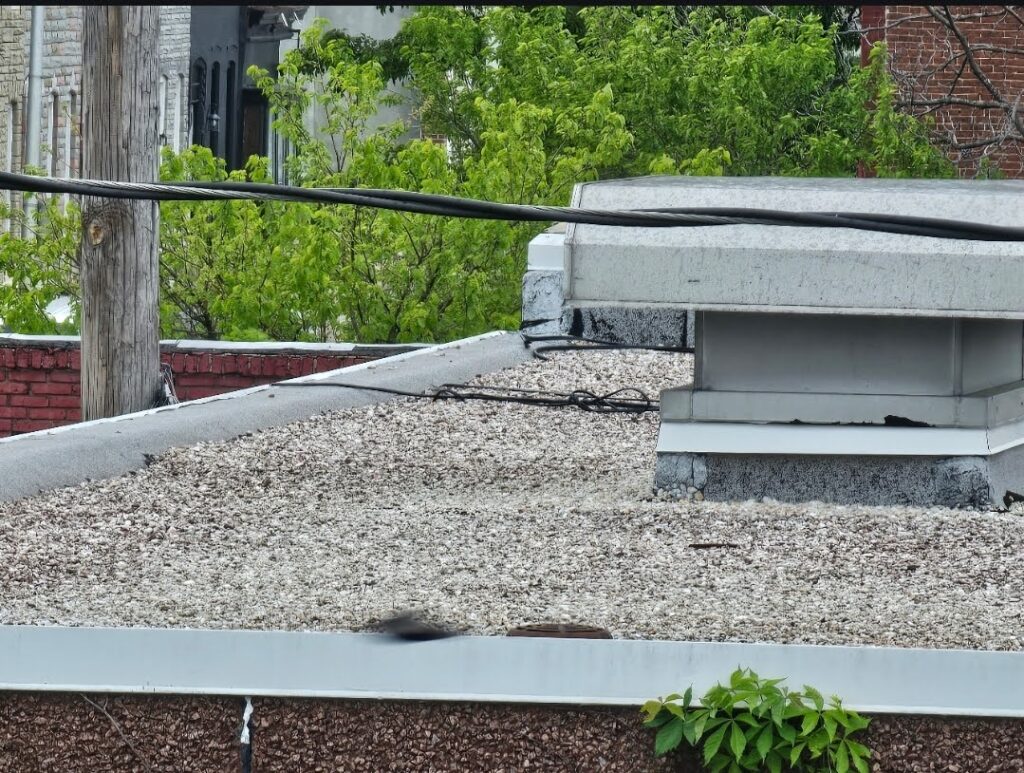
The ballast placed on roofs has two main purposes. The first purpose is to protect the substrate roof membrane from exposure to ultraviolet rays in sunlight. A ballast does a good job of this because it absorbs all of that harmful UV energy. Just a few inches below the ballast, the low slope roof membrane remains unharmed. Essentially, below the ballast, the low membrane just sits there in the shade. Secondly, the roof ballast also keeps the roof membrane weighted down and therefore set in place.
Typical winds, especially heavy winds or windstorm, can create a very heavy uplift force. Heavy winds can even take entire rooftops off. Certain types of roof membranes such as built-up roofing do not necessarily have an intrinsic method or mechanism of attachment to the substrate. The ballast helps keep the roof in place.
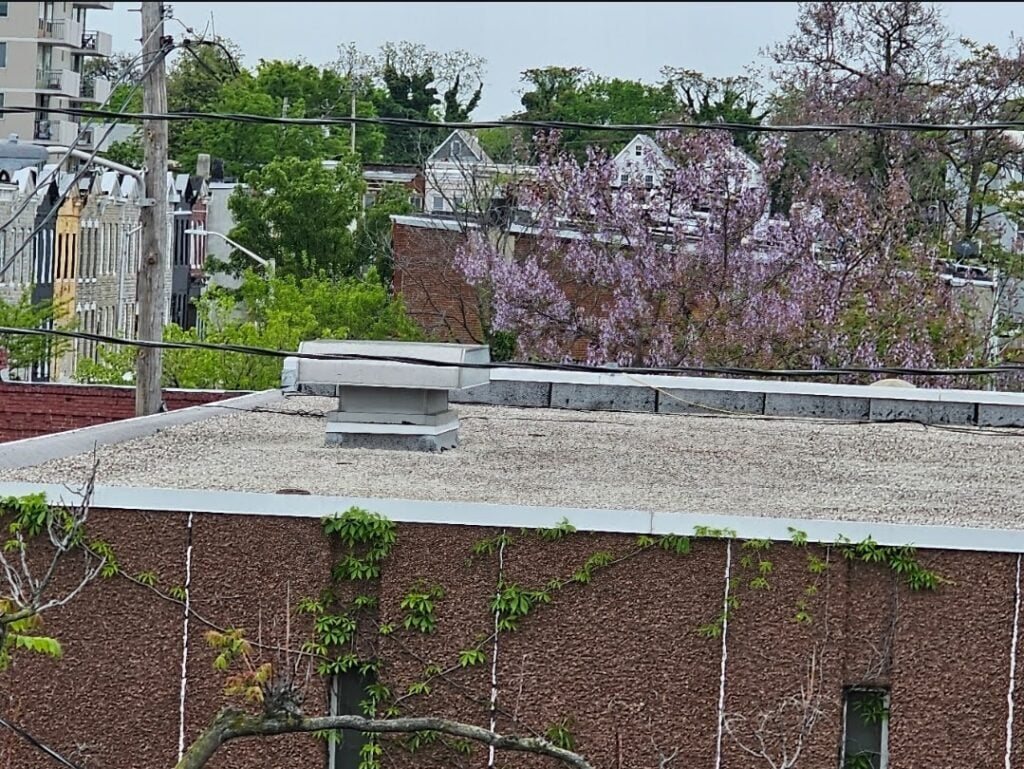
The picture below shows a low slope roof on top of a commercial building. There is a large rooftop cooling unit on top of the roof as well. This roof has internal drains. In most cases, typical row homes here in Washington DC, although flat, generally do not have internal drains. The vast majority of them instead have a low rear termination. The roof is graded with a relatively slight angle of at least 4% towards that rear of the building. From there, where the roof terminates, water is fed over a drip edge flashing into a gutter system. Here though, the roof is too large.
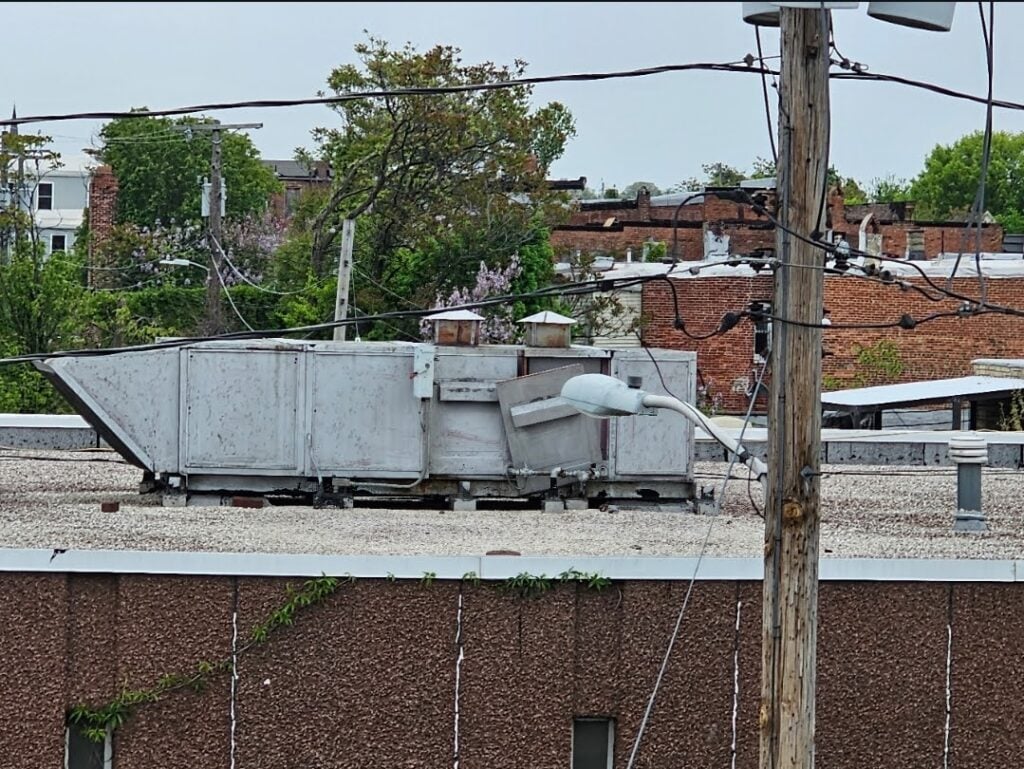
If a roof like this had a single rear termination, it means that the very long path, from front to back or from the low termination to the opposite end of the building must have a 4% slope continuously throughout. If the building, for example, is 100 ft long, with a 4% slope, it would need to have an overall slope of 4 feet. 4 feet might not sound like a lot of build up, but 4 feeti of additional framing means that the walls towards the front must also be an additional 4 ft higher.
If the roof is to be sloped by using tapered insulation then the amount of overall insulation built up is enormous. It’s too much and would be extremely costly.Instead, the internal drains allow for a drain at intermediary points along the pathway of the roof. For example, in the same scenario of a 100 ft long roof, if a drain is placed every 20 feet then the maximum distance that any spot on the roof has to go to the drain is roughly 10 ft. 10 ft only requires a buildup of 4-7/8 inch. That limited amount of build-up is much more manageable, from a framing and construction perspective.
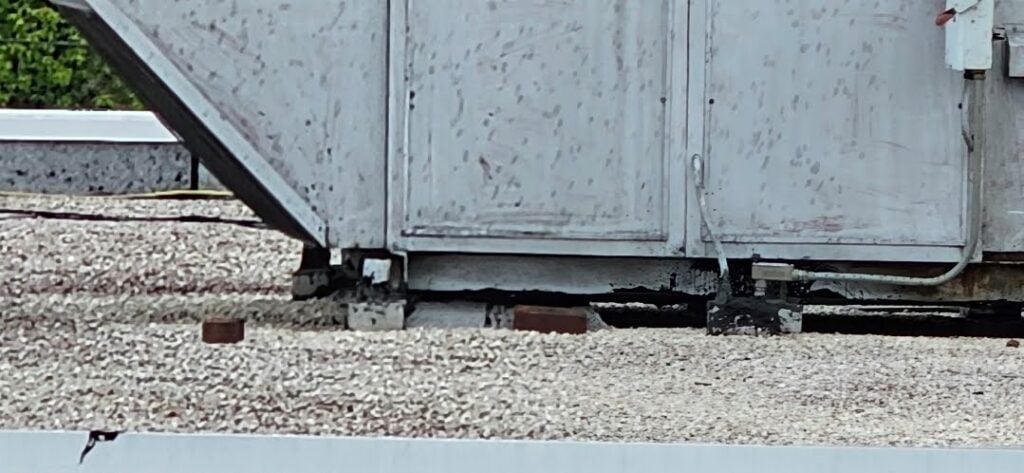
In the next picture below, you can see the base of the mechanical unit. There are a few different ways mechanical units of this size can be mounted. One of simplest ways for relatively small equipment is tp just set the equipment on a framework of dunnage. Dunnage can be something as simple as a frame.. The framework will be a purpose built frame made to support the equipment but it, in some minutes cases, lay on a slip sheet set directly on the roof.
In some cases, some mechanical contractors set their mechanical product directly in the membrane without a dunnage system and even having a slip sheet to separate the roof from their mechanical unit. That’s wrong. It shouldn’t be done like that.
Even lightweight small condenser units should be separated from the roof membrane with a slip sheet. A slip sheet can be something as simple as a scrap remnant or excess roof membrane material that’s used as a sacrificial mat. Even small mechanical units have micro movements typical in their operation that can wear out the roof membrane. As the equipment operates day after day, month after month, that constant micro-movement will eventually damage the roof membrane. The slip sheet provides an extra layer of separation to protect the actual roof membrane.
In some cases, large commercial mechanical equipment will be set on rooftop equipment support frames / platforms. In most cases these frames are built with heavy structural steel. In some cases they can also be built with lightweight tube steel and even heavy metal stud work, in some cases. The difference between structural steel and light gauge steel is significant, but even light gauge steel can support a relatively heavy load.
Light gauge steel is often referred to as cold rolled steel. The cold rolled aspect of the name prefers to the fact that the metal is often formed from galvanized flat sheets. It’s produced or manufactured in flat sheets and then cut into strips. Then the flat metal is forced through a machine that rolls the edges up and turns it into pieces of metal that resemble stud work. When rolled, the edges are turned into a box type shape, like a stud.
It is loose and bendable in the sheet form, but when bent up into a box type shape it becomes stiff because of the angled corners. Those angled corners create a field of resistance that stiffens the individual pieces of metal. By comparison, hot rolled steel is very thick and extremely strong. It can only be bent and formed, even by heavy machinery, when it is red hot. When red hot, it’s in a moldable and malleable form. Once the metal is then cooled, it becomes very strong and very stiff. It has an intrinsic high compressive and high tensile strength.
We provide this information here on our blog, and our website, to help our customers and future clients, and we recommend every building owner in DC who values the longevity of their roof (and their investments) and building use a contractor who values the simple and important principles of proper roof construction like Dupont Roofing DC.
Our company specializes in flat roofing here in Washington DC and we’re happy to help building owners of almost all types. Learn more about our company and the proper techniques of working with roofing on historic buildings in Washington DC here on our blog at DupontRoofingDC.com, and you can call us at (202) 840-8698 and email us at dupontroofingdc@gmail.com. We are happy to help and at least talk through options.