Understanding Leaks Around Flat Roof Penetrations
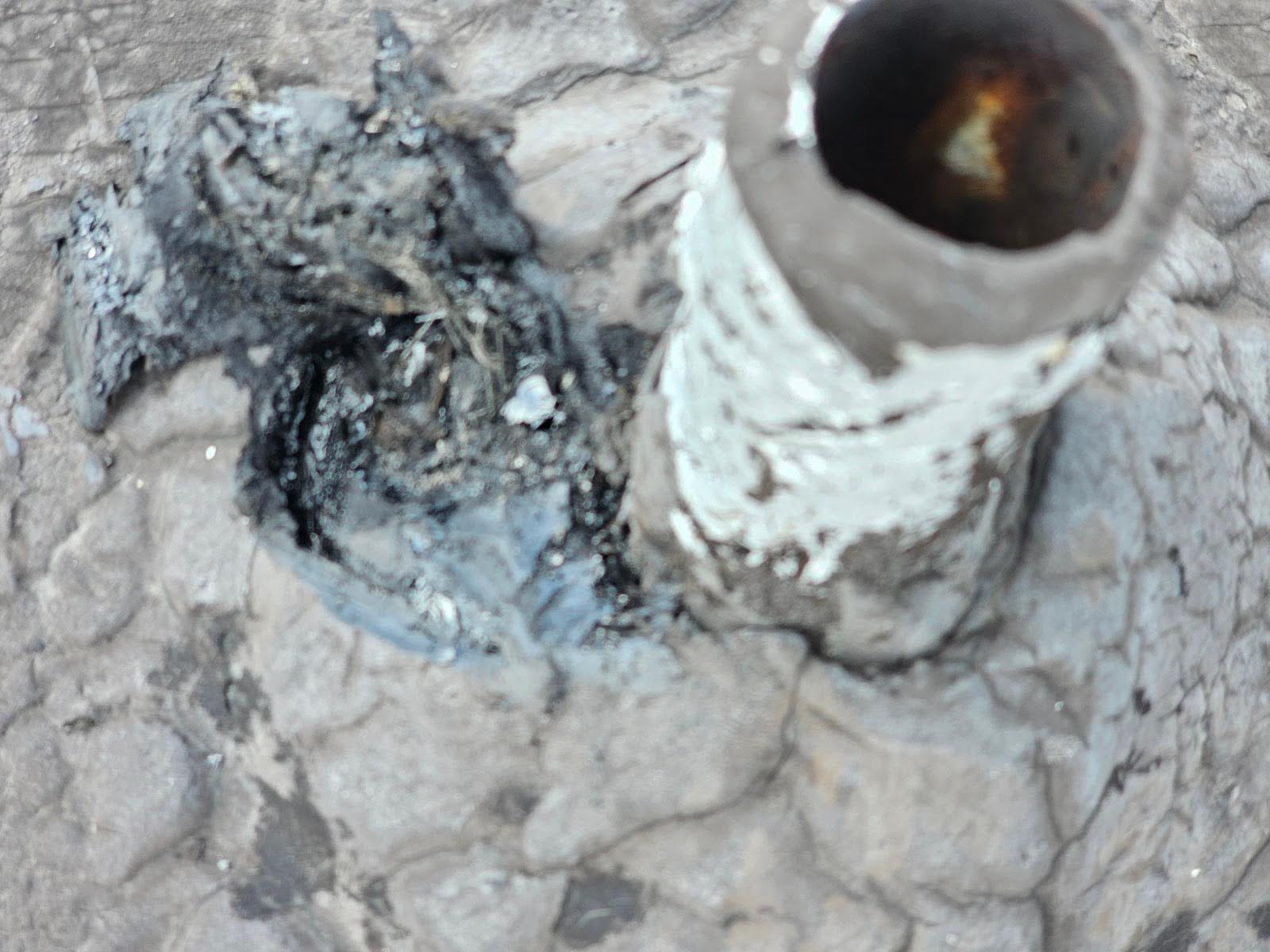
We’ve looked at a handful of jobs just like this where we had to go back and take off the work of other contractors where they slapped on this asphaltic mastic and or cold-process tar where it didn’t belong. We’ve even shown some of the pictures from those other roofs here on our blog and website before. Instead of doing a professional repair, when there were concerns about leaks in the past, some low quality, cheap people who didn’t really know how to work on roofs went and just smeared on a bunch of tar. They went to the spots where it was most obviously an area of heightened concern which is the pipe penetrations.
This particular roof has several pipe penetrations and they didn’t skip any, they went around to each one and smeared this tar-like material all over it. It’s a problem now because it’s harder to remove and it doesn’t belong there. To remove it now, it’s more complicated than it would have been just to do it right the first time. Now the surface needs to be heated and the remaining tar, although partially deteriorated already by exposure to ultraviolet, has to be scraped off with force.
If you look closely in the picture below, you can see that this asphaltic type tar looks like the texture of an alligator skin. It’s rough and it has crevices and cracking within there’s little crevices inside of the application. Those areas were all concerns. Just from a visual look, you can see that the materials are falling apart but it doesn’t mean it’s easy to remove because it’s still well stuck to the roof.
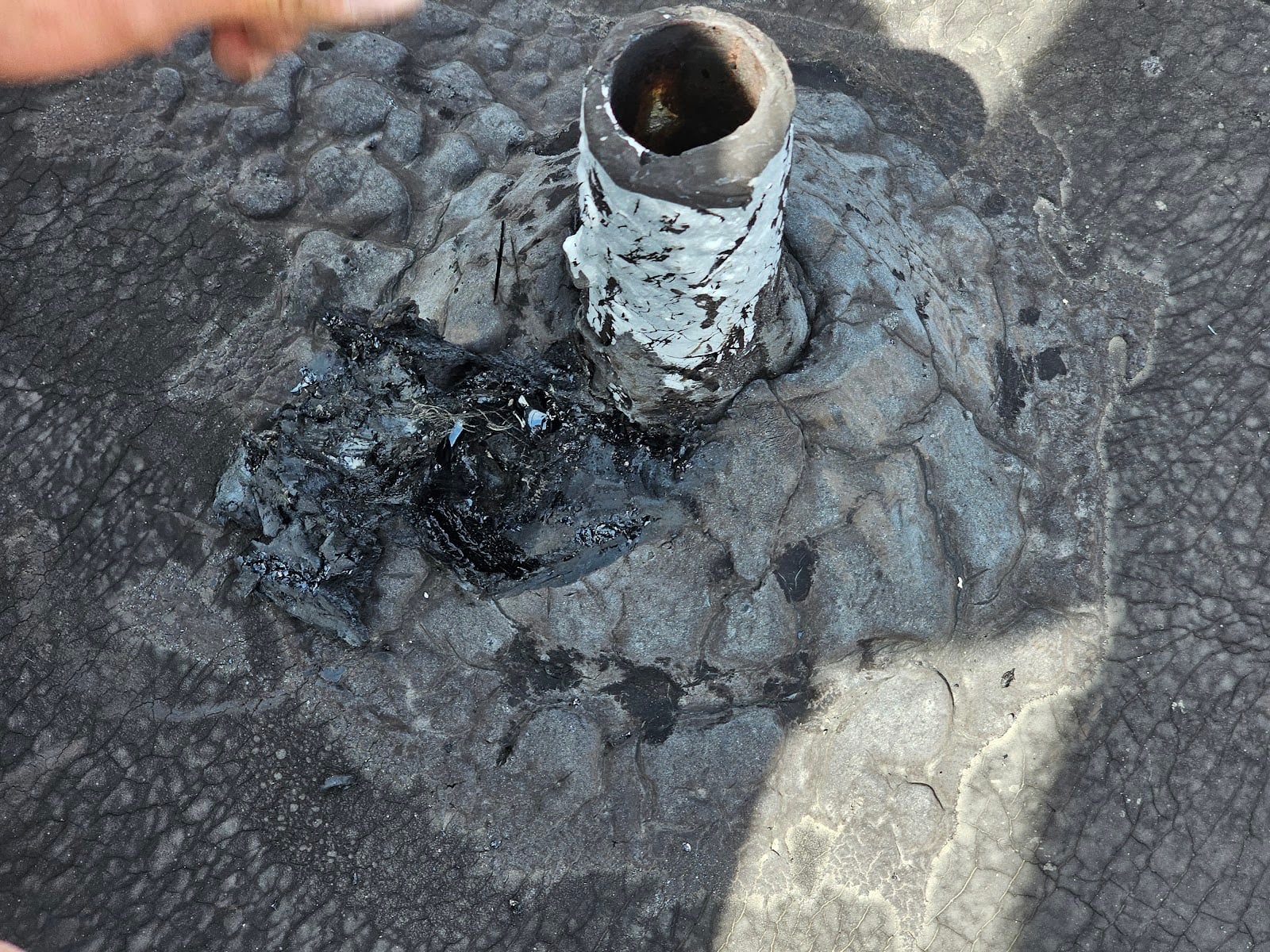
The reason it has to be fixed now even though they considered what they did to be a fix, is that it didn’t work. This tar application has no inherent resistance to the deleterious effects in natural ultraviolet rays in sunlight. UV deteriorates and damages a lot of different building materials including most types of roof membranes. But when applied properly, modern single-ply roofing membrane materials can be installed so that they can last for decades. Not just a few weeks or months.
The problem is that the industry happens to sell these kind of smear on tar applications right in the big box stores. Amateurs and DIY homeowners who don’t really have the accounts and / or the experiential wherewithal or the industry knowledge to know that this material won’t work well nor the experience to know where to procure the professional alternative materials. It’s not difficult, but the materials that they really needed are not sold in a big box store. In other Industries and other types of repairs, such as carpentry or concrete, cement or even electricity or plumbing, it’s easier to procure proper materials for home repairs.
In the picture below, you can see where we took a hot scraping knife and removed a part of the piled on tar. The surface below also looks rough but it’s a brighter color because it hasn’t gotten dirty with dust over the past few months to make a change from a bright black to a dull gray.
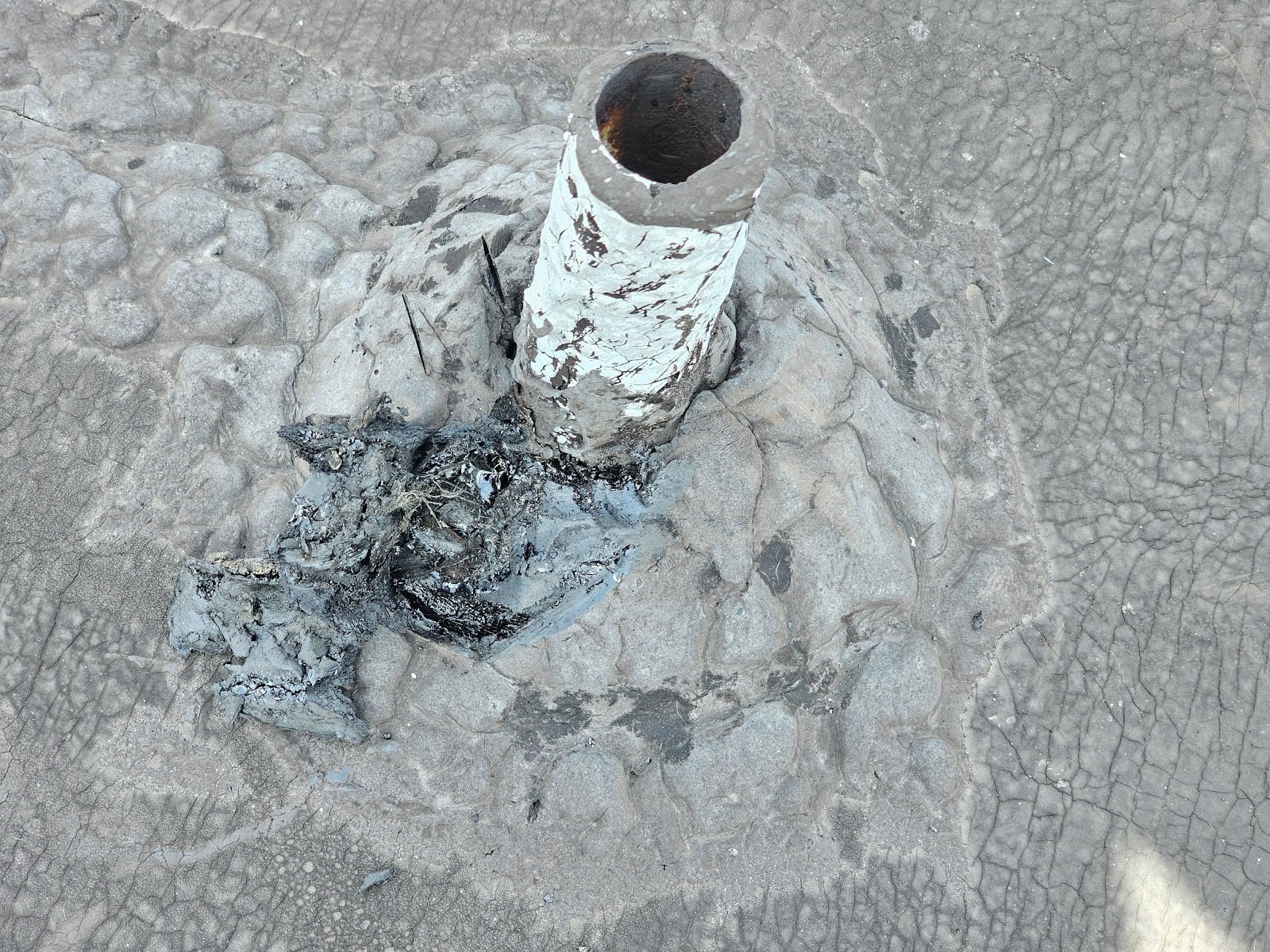
One of the many problems with the installation that these people did in the past is that as you can see in the picture below when you look closely. The materials are not monolithic. They’re stacked on in layers and there is separation between them so as water gets through the upper level of cracking, it will seep down and then spread out or run through the lower level below.
It just peels away. Here you can see where I pinched a part of it and just peeled it back. There are a few different types of single-ply membranes available today. One of the older types is modified bitumen and this is an example of that class of roofing materials. It’s much newer and works much better than some of the even older systems like standing seam metal roofs or built up roofs. Unlike built up roofs, single-ply memories like this are much lighter weight.
They don’t have thousands of pounds of ballast imposed and set on top of a roof system. That makes them better in some ways from a structural perspective. Without the thousands of pounds of ballast on a typical built up roof, the built up roof could literally just blow away because it isn’t really secured to the substrate below. It’s basically what we sometimes refer to as loose laid. The ballast not only holds it in place though. It also protects it from exposure to ultraviolet light.
In this coming week we’re going to talk about the process and show pictures of the repair applied to this roof membrane.
We provide this information here on our blog, and our website, to help our customers and future clients, and we recommend every building owner in DC who values the longevity of their roof (and their investments) and building use a contractor who values the simple and important principles of proper roof construction like Dupont Roofing DC. Our company specializes in flat roofing here in Washington DC and we’re happy to help building owners of almost all types.
Learn more about our company and the proper techniques of working with roofing on historic buildings in Washington DC here on our blog at DupontRoofingDC.com, and you can call us at (202) 840-8698 and email us at dupontroofingdc@gmail.com. We are happy to help and at least talk through options.