Understanding Low-Slope Green Roof Systems – Part I
There are a handful of green roofs here in Washington DC. The different funding agencies will often require or encourage Green Building practices. Although alternative methodologies are available to achieve Green Building credentials, green roofs are considered a relatively obvious area to improve or offset the environmental impact of a building. There are a lot of different ways to look at environmental impact but some investments have lower first cost and higher lifecycle costs or vice-versa.
From a counterpoint type perspective, there are certain buildings that are part of an initiative or field of autonomous building construction. It’s not exactly the same as Green Building practices, but there are lots of similarities. Autonomous building construction, in just a few words, is about creating buildings that can be built off the grid and require very little upkeep and maintenance.
Essentially, they have a very low energy footprint because they aren’t connected to any grid that consumes energy or creates pollution. Everything about them is detached. It’s not at all the same thing as green roofs, but there are some similarities because green roofs. Some of the elements of these practices are pushed or encouraged as part of Green Building construction, and autonomous building construction has many overlaps.
The picture below shows the green roof on top of a moderately low sloped building roof. As we’ve discussed here on our website, in the past, many of the modern single-ply low slope roof membranes are required to be built with a minimum slope at all points of the roof system. Essentially, they have to at least avoid ponding and in some cases have a quarter inch or more of slope per linear foot at all points of the roof.
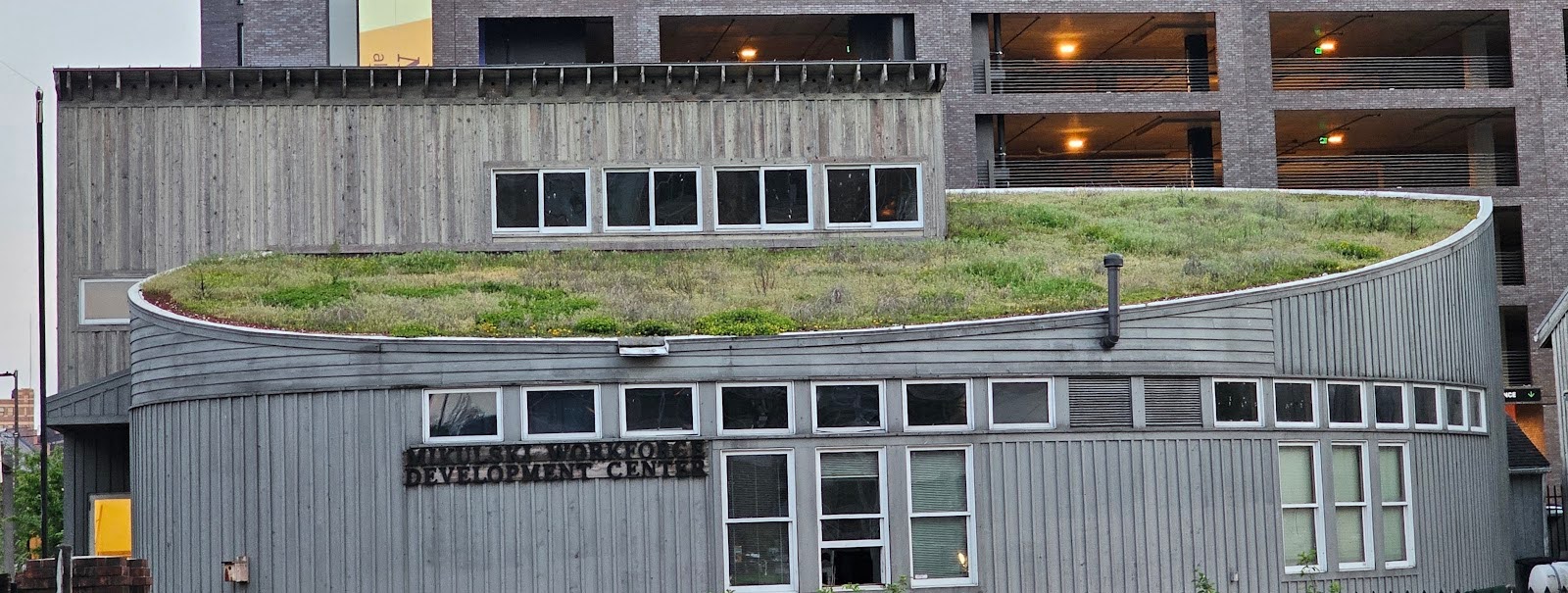
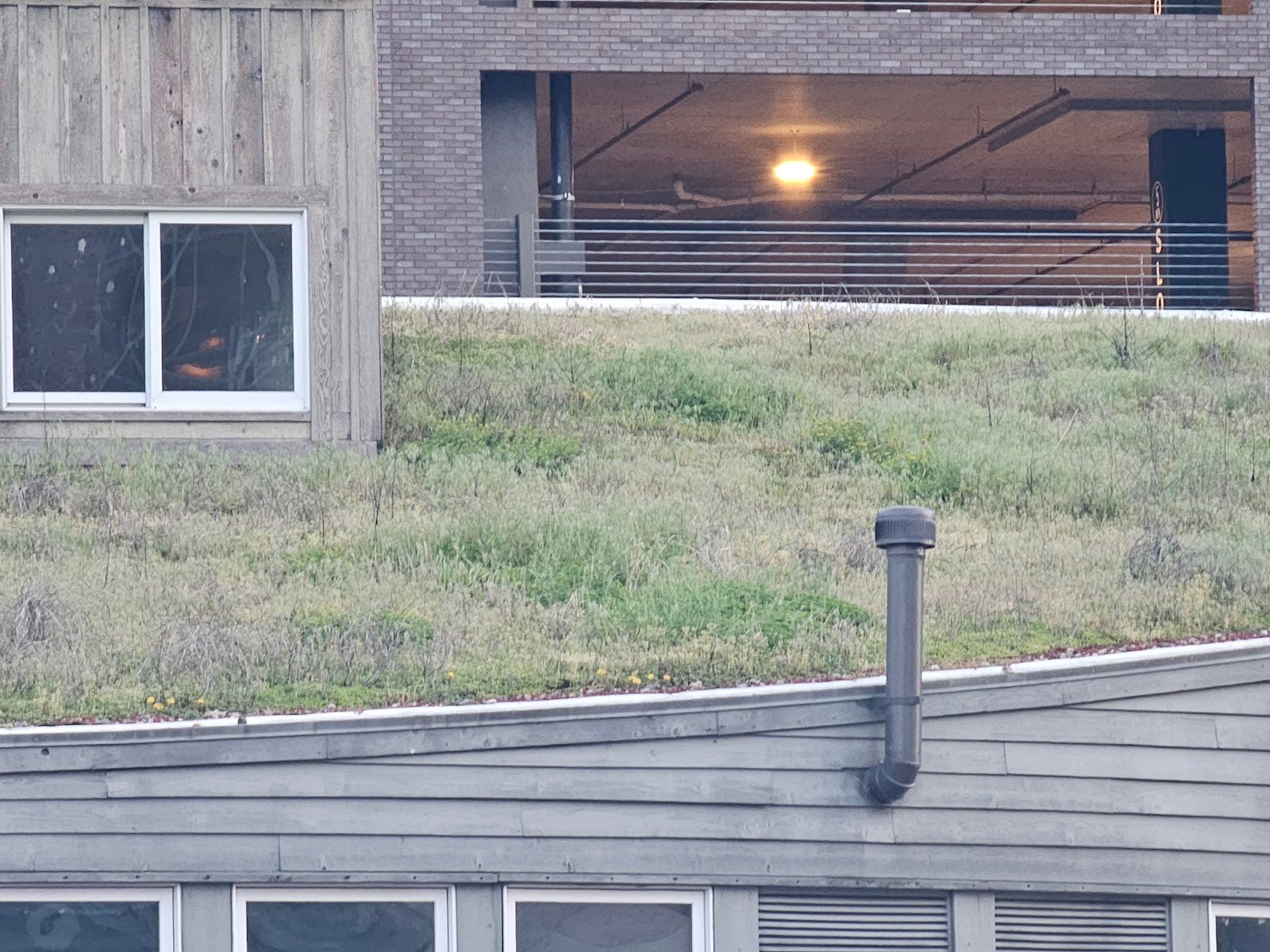
When you look, from a distance, at the plant life at this particular roof, it just looks like grass. Grass itself can be very effective from an environmental perspective. In addition to giving back to the environment in the form of photosynthesis, it does a few other important things to help the environment. It reduces the overall runoff and therefore the burden on our storm sewer system. In Washington DC, much of the storm water system is mixed with the sewer system. It’s a complicated mess that goes back to the original construction of the city over 100 years ago.
Every once in a while there will be heavy storms that drop tons of rainfall in a relatively short period of time. Even though super heavy rains are infrequent, the system needs to be able to handle those types of critical events. When the system is overwhelmed and or incapable of handling a heavy storm, it leads to major problems such as flooding and backup. Literally, millions of dollars of damage can be caused by a system’s inability to handle a critical storm event.
By there being a green roof, here for example, it doesn’t mean that the rain that falls onto that roof won’t end up in the storm system, it just means that it won’t entirely end up there and there is a buffer that delays the time of the runoff. That might not sound as important as it is. It’s incredibly helpful because the problem with critical precipitation events isn’t just the volume, it’s the amount of time in which that volume is applied. For example, a slow rain storm that lasts continuously for 5 days would be considered a very long rainstorm.
If that rainstorm were to only be a very light rain it might only have less than an inch of total rainfall per day. Five inches of rainfall spread out over 5 days is something our system can handle.
However, by comparison, on July 8th 2019, we had a massive rainfall with 3.44 inches of rainfall in just a one hour period. Even though that is less rainfall than our example of five inches of rain in five days, because of the short amount of time compared against the long amount of time, the 3.44-in rainfall in just a one hour period caused major problems. The green roof is an example of a type of roof system that doesn’t shed water directly off into the storm sewer system.
Instead it holds that water for at least a period of time and then lets it drain slowly. It helps by reducing the impact to the storm sewer system by delaying the flow of the water, and also a portion of that water is absorbed and used by the plants. A portion of it also stays there inside that plant medium and then from there evaporates. These things really help the storm system and help the environment.
We provide this information here on our blog, and our website, to help our customers and future clients, and we recommend every building owner in DC who values the longevity of their roof (and their investments) and building use a contractor who values the simple and important principles of proper roof construction like Dupont Roofing DC.
Our company specializes in flat roofing here in Washington DC and we’re happy to help building owners of almost all types. Learn more about our company and the proper techniques of working with roofing on historic buildings in Washington DC here on our blog at DupontRoofingDC.com, and you can call us at (202) 840-8698 and email us at dupontroofingdc@gmail.com. We are happy to help and at least talk through options.