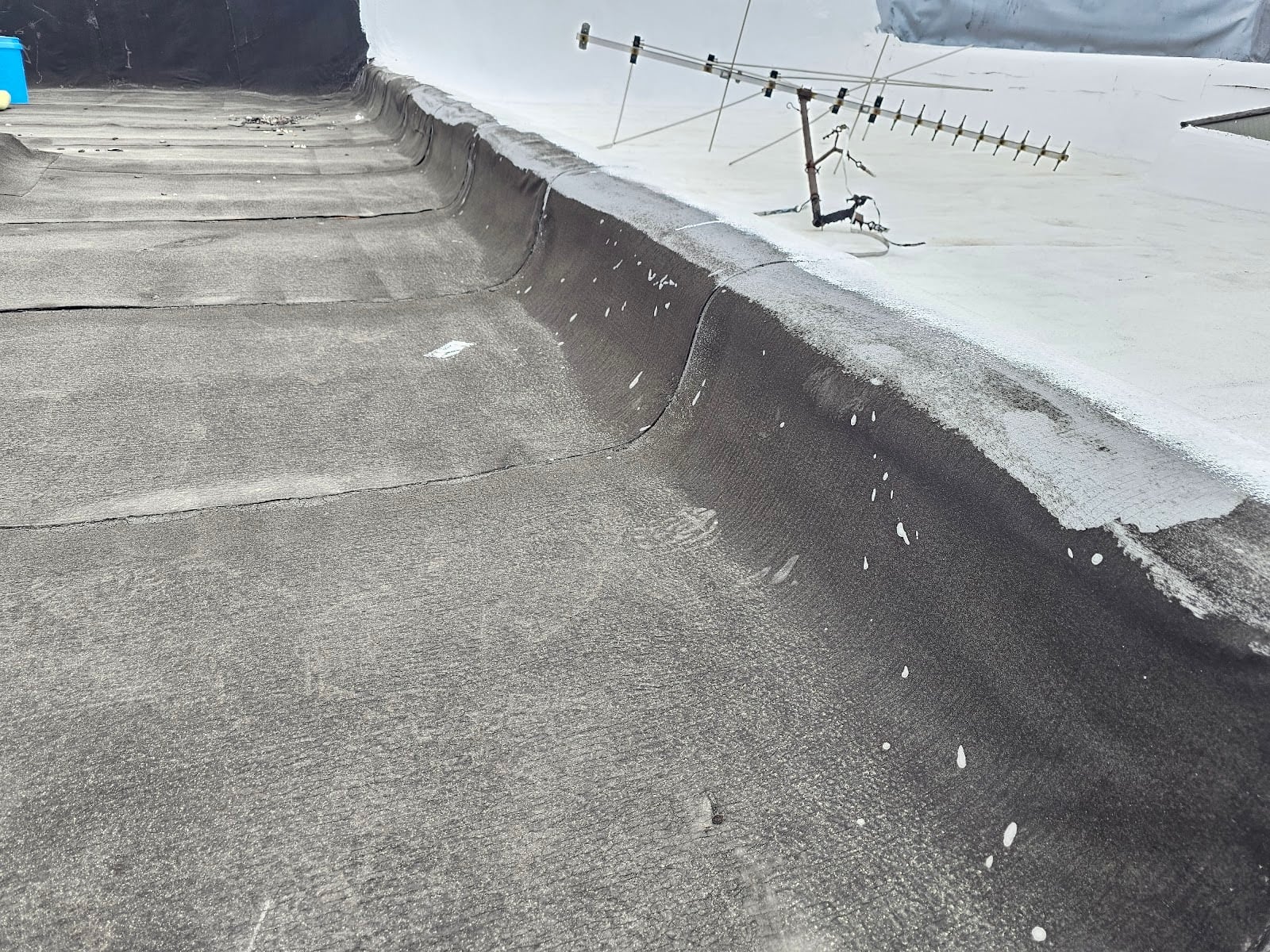
Understanding Shiners in Horizontal Roof Surfaces – Part I
Here on our blog, we’ve shown examples of good work that’s been completed the correct way and we’ve also looked at several examples where things have been done improperly by other contractors. We think it’s good to understand and learn from the mistakes of other contractors so we don’t have to make them ourselves. Not to assume the worst, but it seems that many contractors don’t place a lot of value on quality control. We feel like quality control and continuous improvement are centrally important to building an industry leading practice in flat roof construction.
Often, clients call us to fix the work of other contractors because even after they complete their work, it’s still is full of defects which lead to life cycle upkeep issues. The picture below shows a skylight and a gooseneck roof vent. PVC roof vents could be used for drain-waste-vent systems which are part of the plumbing of a building. Here, this PVC gooseneck could have also been used to vent or exhaust air from a top floor bathroom or other part of the house.
A gooseneck is not required for a drain-waste-vent termination. Many of the contractors don’t necessarily understand the difference though and may install it in a mistaken attempt to do something correctly. Here the big problem though, and the big mistake, is that they installed a residential roof boot on a low slow roof system.
Low slope roof systems may be used on residential buildings, particularly here in Washington, DC. However, they’re not classified as residential. Instead of a low slope roof system is generally classified as a commercial and industrial system. Here, flat roof buildings were built over 100 years ago, in Washington DC. These houses were often built i rows and joined through the tight layout density. The roofs were often built flat since the buildings were joined at the sides and because of associated fire prevention.

The problem with flat roofs is that they aren’t common for typical residential construction outside of densely built urban downtown adjacent areas like here in Washington DC. In the rest of the sprawling suburbs that surround Washington DC, there are near-endless seas of stick frame pitch roof buildings built in tight Smurf Village developments where houses are just a few feet apart but separated from one another. Those buildings have pitch roofs which are generally clad with asphalt shingles or another type of inexpensive roofing material. The type of roof boot installed, in this particular example, can be installed correctly in a shingle roof. It doesn’t work for flat or low-slope roofs though.

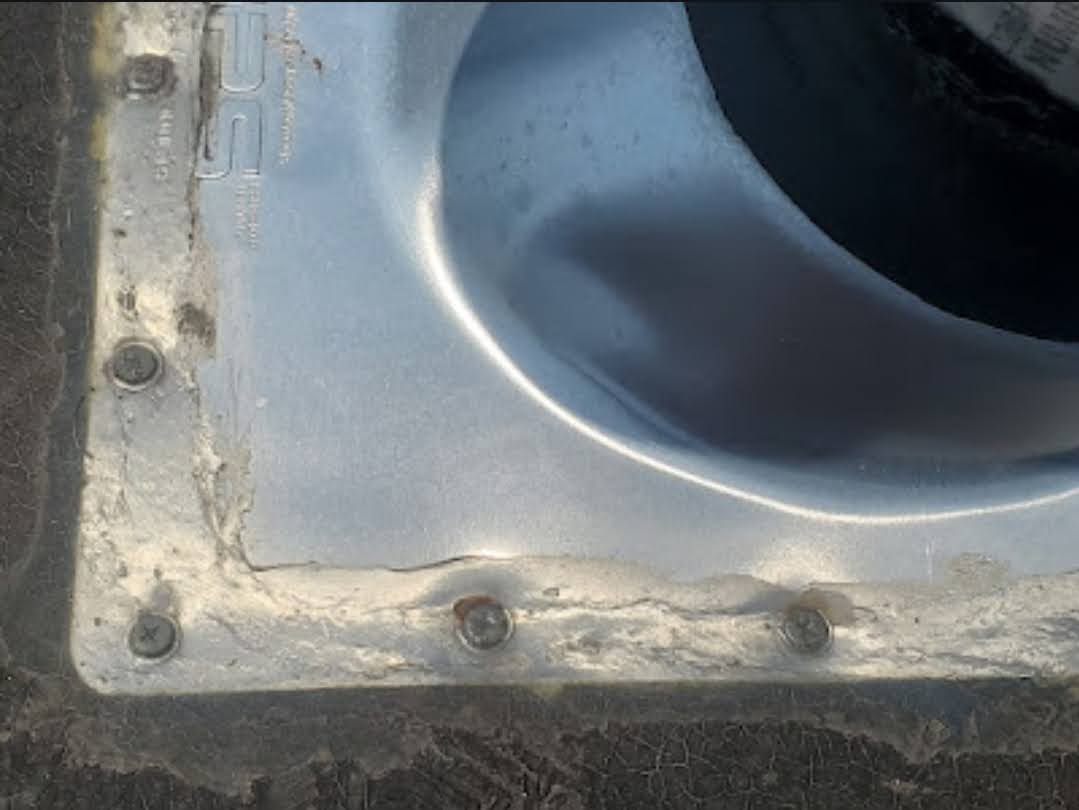
The base of the area around the pipe is attached in an integral connection between the neoprene or flexible black gasket and the silver looking aluminum sheet metal. That aluminum sheet metal essentially works like flashing around the base of the pipe. The black flexible material is tied directly to the aluminum base and sealed from the factory manufacturing process. The problem here is just that it wasn’t intended for this type of installation where it’s installed directly on top of a flat roof. It’s intended to be overlaid with shingles set in a sequential process from the lower part of the roof towards the upper part. In that type of scenario, the nail heads become covered.
When nail heads are left uncovered like this, it’s particularly problematic. In a low slope roof configuration, because water doesn’t flow nearly as quickly, the water has a tendency to puddle / pond more, depending on the type of precipitation, than it would on a higher pitch roof. These exposed fastener heads create a particularly problematic issue when exposed on a flat roof. There are no circumstances where it’s acceptable to have completely exposed fastener heads like this. Here they smeared on a type of caulking but that type of caulking also isn’t intended to be installed as a roofing sealant.
In this coming week, we’ll talk more about the proper types of methodologies and the problems that are inherent with this type of erroneous installation. Sometimes simply understanding the types of materials that are supposed to be used makes all the difference.

We provide this information here on our blog, and our website, to help our customers and future clients, and we recommend every building owner in DC who values the longevity of their roof (and their investments) and building use a contractor who values the simple and important principles of proper roof construction like Dupont Roofing DC. Our company specializes in flat roofing here in Washington DC and we’re happy to help building owners of almost all types.
Learn more about our company and the proper techniques of working with roofing on historic buildings in Washington DC here on our blog at DupontRoofingDC.com, and you can call us at (202) 840-8698 and email us at dupontroofingdc@gmail.com. We are happy to help and at least talk through options.