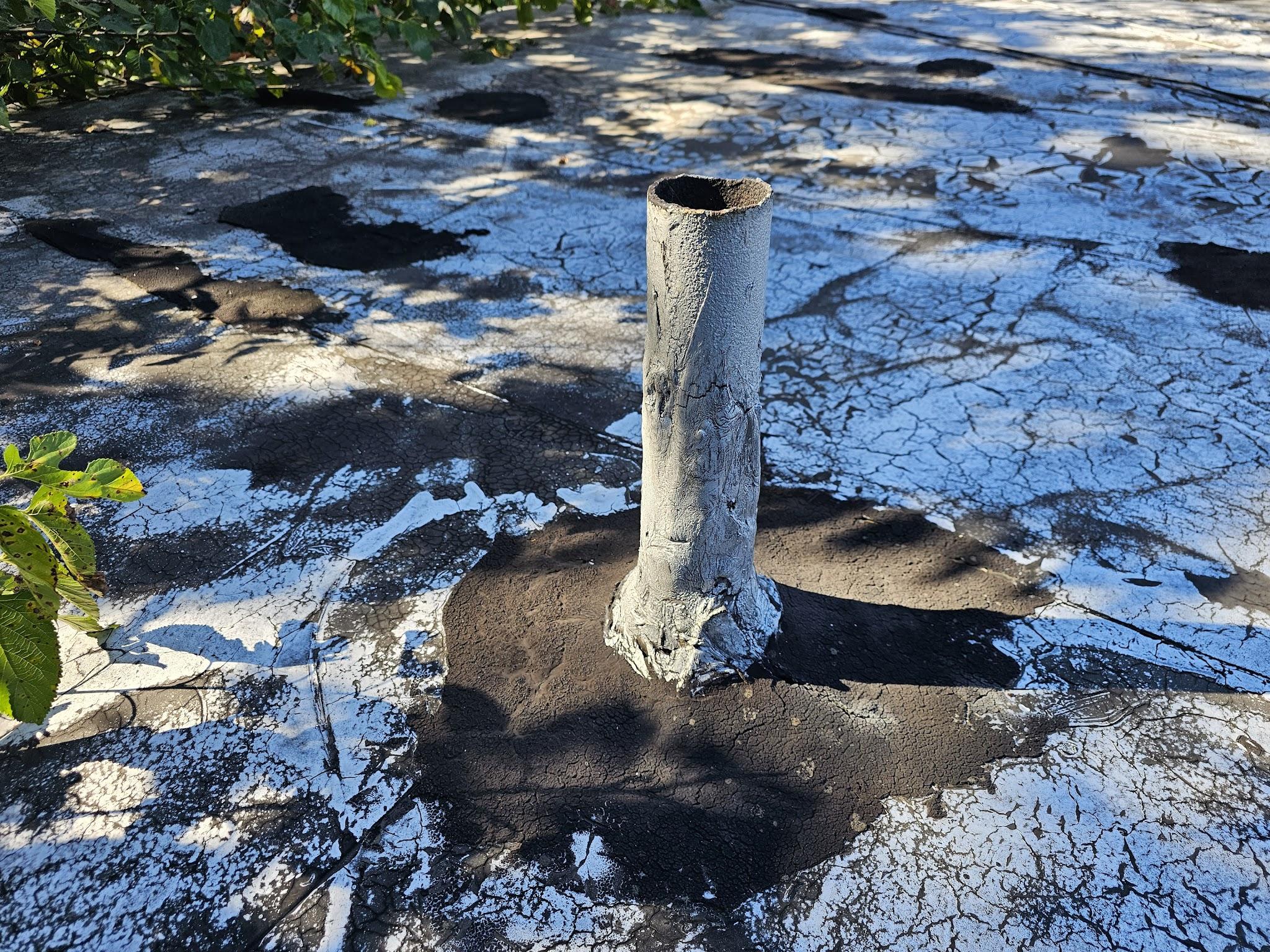
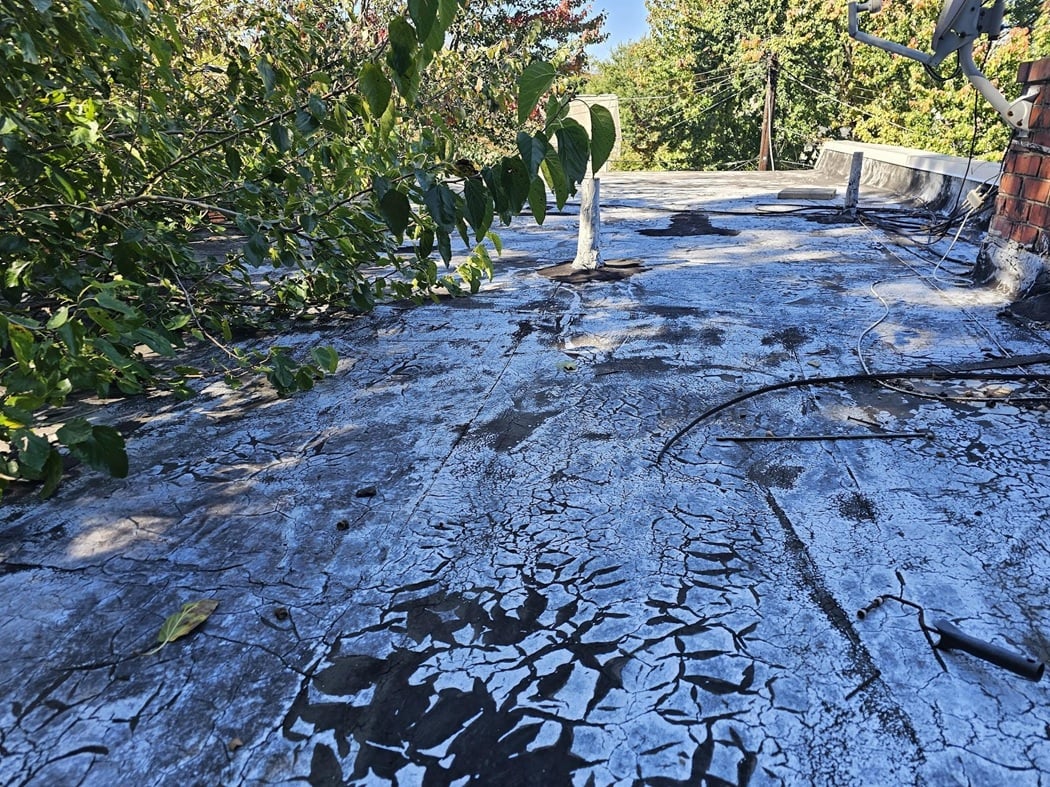
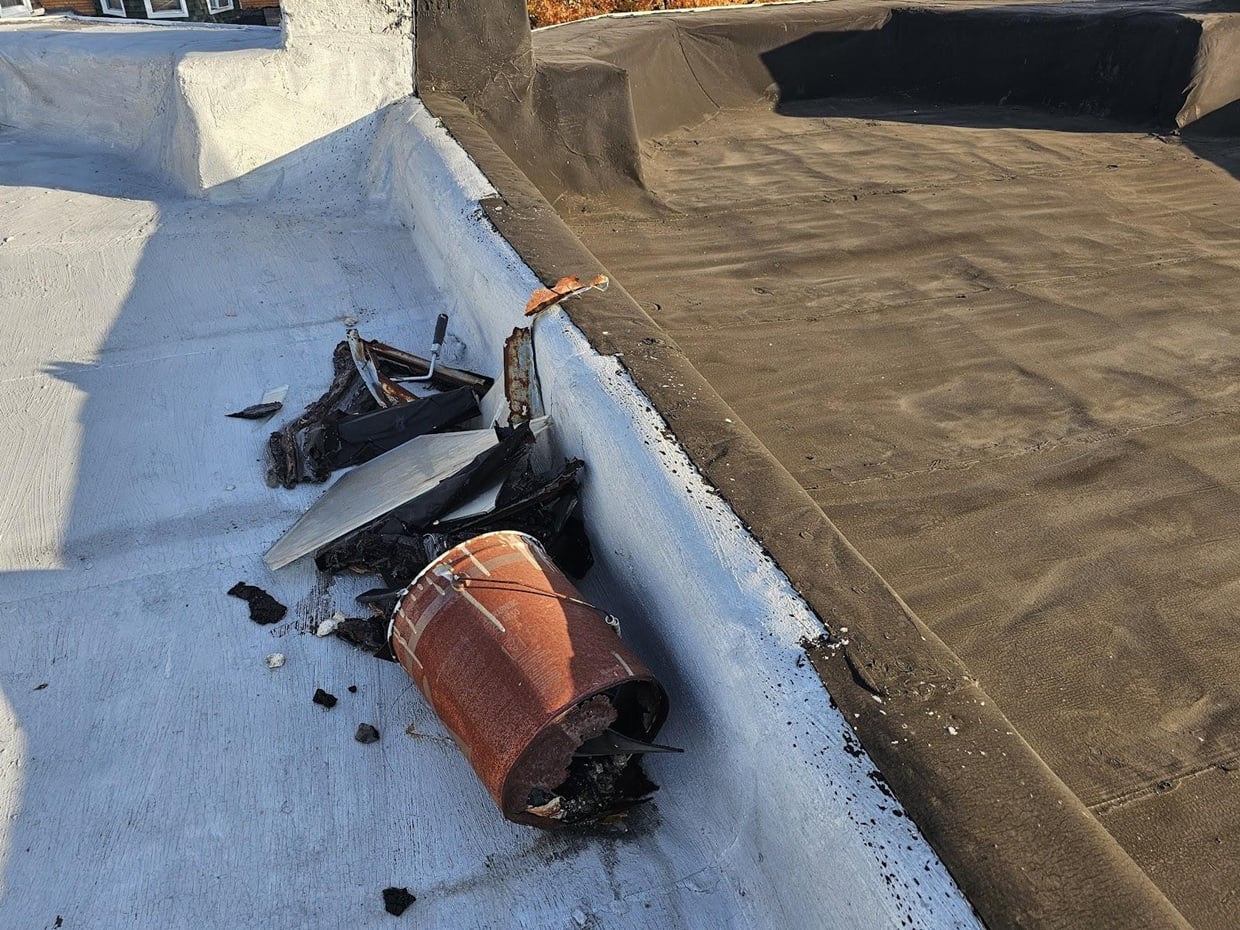
We find problems like this all the time, where some previous contractor didn’t really know how to torch weld yet installed a modified bitumen roof without proper welding. It’ll generally leave the lap joints insufficiently bonded which will lead to delamination and leakage.
Years ago, when the last previous contractor came, they figured the best way to treat it was to essentially smear asphaltic tar all over the tooftop surface. We would recommend against this type of treatment, in this context. This isn’t entirely different to the way that hot mop built up roofs were commonly built years ago. It’s not the same though. The big difference is that the asphaltic material applied here on top of the modified bitumen roof was not a hot-tar material. It happens to have a lower temperature melt point.
Even though we don’t think that that type of application is appropriate to treat this type of roof comma it’s good to understand how the historic tar covering worked. Essentially, historic hot-mopped built-up roofing materials also had a similar dark, viscous appearance. Their precise material formulas had specific behavioral characteristics. Coal tar pitch, for example, has a significantly lower softening point than roofing asphalt. This lower temperature point for activation made it liquefy at lower temperatures and even “self-heal” micro-fissures on typical summer season warm days. To prepare these built-up tar materials, large, heavy blocks of bitumen were cooked and melted down inside a propane-fired kettle until they reached a fluid, pourable state.
This hot liquid was then applied to the roof surface, mopped ot spread into place, and then worked into a realtively uniform layer. While the substrate was still hot and tacky, reinforcing layers of fiberglass or organic felt plies were embedded into that hot tar. Sucessive inter-ply coatings of hot bitumen were applied. This multi-step repetitive process created a multi-layered membrane.
Modified bitumen roll roofing are different but nonetheless similiarnin that, the unprotected bitumen layers are highly susceptible to UV energy. Smooth-surfaced built-up roofs are highly volatile environments for standard topcoats. Commonly, stone aggregate was preferred over paint, on built-up roof sytems because raw tar can soften significantly under typical daily summertime hot temperatures.
This high viscosity and fluid thermal shifting make it a poor substrate for rigid coatings. The tar roofing lacks the elasticity to remain bonded over a moving foundation. Without aggregate ballast to shade the roof and block ultraviolet radiation, a painted asphalt substrate will continuously expand and contract under daily thermal cycles.
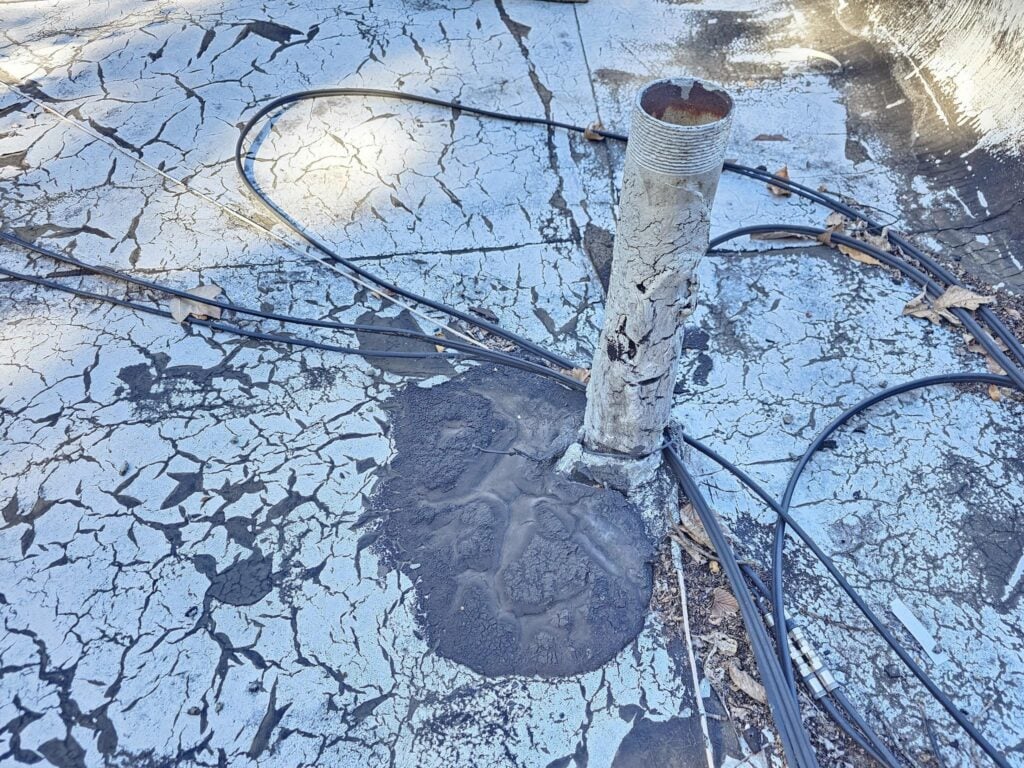
This instability leads to movement which creates stress on almost any applied protective film. If the coating is brittle or applied too heavily, it cannot withstand this typical and residual surface tension. That pressure causes the system to tear open and fracture as the surface skin splits apart, as you can see here.
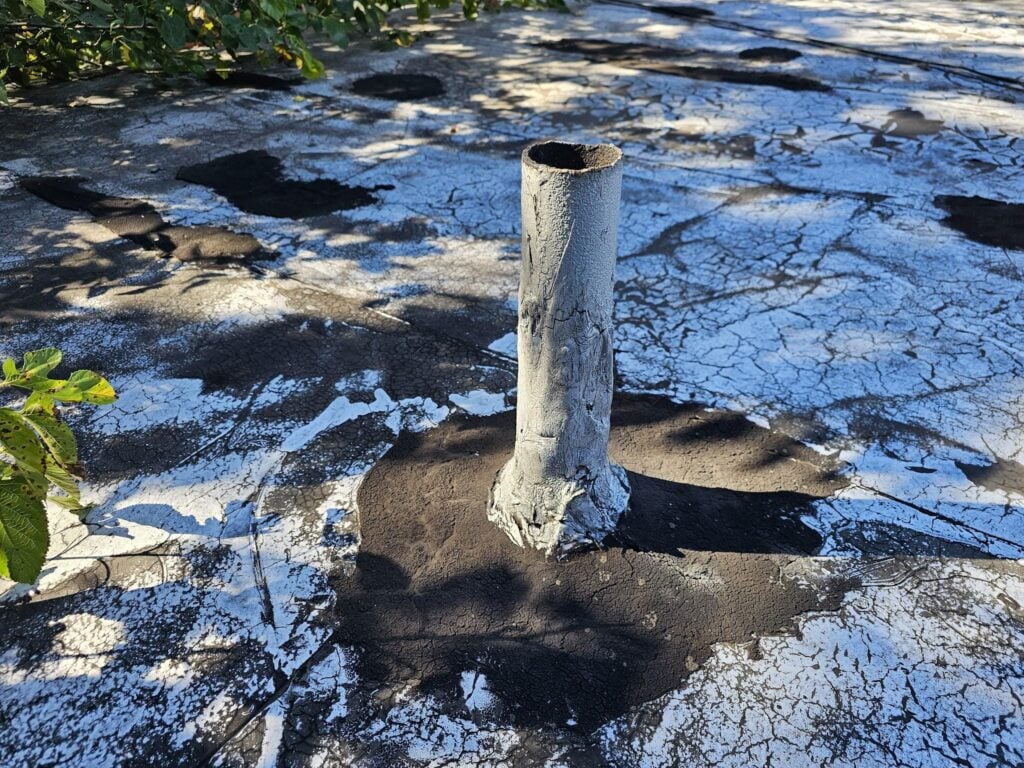
When evaluating a smooth-surfaced tar application on a roof that has quickly aged past simple weathering into severe surface distress, this mud cracking instantly tells you something was done wrong. The fissures show two types of failure: classical thermal alligatoring and deep mud cracking. True alligatoring is a long-term wear that is stress-induced degradation. That means that it takes a long time for it to happen and when it does come of the surface breaks down. Uv is a type of radiation comma array comma in sunlight.
Unimpeded exposure like this causes the oils and stabilizers designed and engineered inside of the roofing materials to break apart. Essentially It’s a type of chemical stripping which breaks down these materials and oxidizes the remaining bitumen. That oxidation leaves the remaining elements brittle and rigid. Rigidity doesn’t sound like a bad thing, but when it’s brittle and overly rigid such as in this circumstance, it is bad, The materials will tear apart instead of moving with some inherent flexibility as really intended.
Later, when they applied a coating to protect the remaining elements, the substrate still had excessive movement. At the location of the most significant movement, where the lines of the mud cracking occurred, It broke apart the protective coating on top.
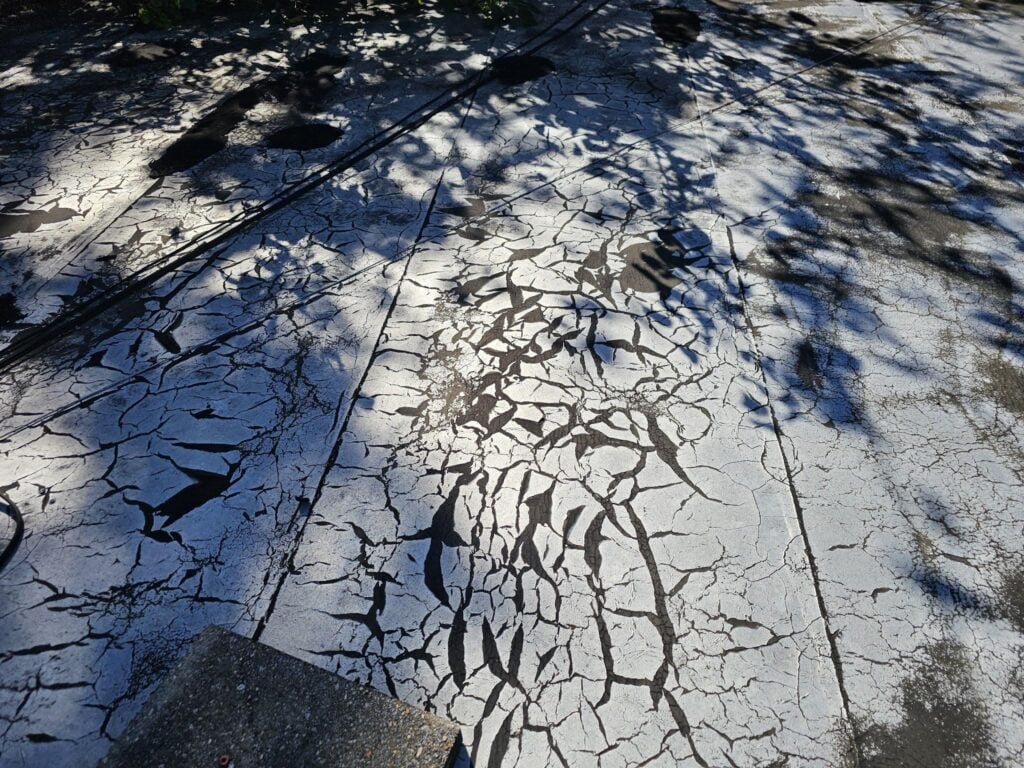
The view below shows an area of this mud cracking at the upper surface a little bit closer. Here, you can see the lines of the edges of the roll roofing at both sides of the photo, running vertically in the frame. Even though this relatively thick application has been applied, this seams are still telegraphing through.
This indicates there is movement at those seams which indicates that they are poorly welded. That isn’t necessarily saying that this application was the right approach, but some type of additional remediation was in fact warranted.
We provide this information here on our blog, and our website, to help our customers and future clients, and we recommend every building owner in DC who values the longevity of their roof (and their investments) and building use a contractor who values the simple and important principles of proper roof construction like Dupont Roofing DC.
Our company specializes in flat roofing here in Washington DC and we’re happy to help building owners of almost all types. Learn more about our company and the proper techniques of working with roofing on historic buildings in Washington DC here on our blog at DupontRoofingDC.com, and you can call us at (202) 840-8698 and email us at dupontroofingdc@gmail.com. We are happy to help and at least talk through options.