Leak Containment System: Commercial Roof Leak Guide – Part I
Generally, the easiest way to stop a roof leak is to actually fix the hole in the roof. Sometimes other circumstances require repairs to alternative systems. In some cases, there are multiple different types of both roof membrane systems and also utilities that are in the same spatial area that are not easy to separate from one another. In cases like that, generally, things have to be destructively opened to expose the elements within. Sometimes that sort of destructive opening is so costly that it’s better to test first instead. With specific testing, sometimes individual items can be isolated. In this case there was a simultaneous leak at the same area.
The main problematic leak wasn’t related to the roof but was related to condensation from the ductwork. The duct should have been sealed and insulated to eliminate or prevent leakage. Condensation is essentially created by a significant temperature differential. With insulation, the area or differential between temperatures at the metal ductwork could have been limited to the point that the leak would have been avoided. In this particular case though there are several systems of piping above.
In that particular ceiling there are also drain lines that run from the roof down to a concentrated collective main drain. As well, there are fire sprinkler systems and also refrigerant lines. Refrigerant lines can also have concentrations of condensation that leads to leakage in building ceilings.
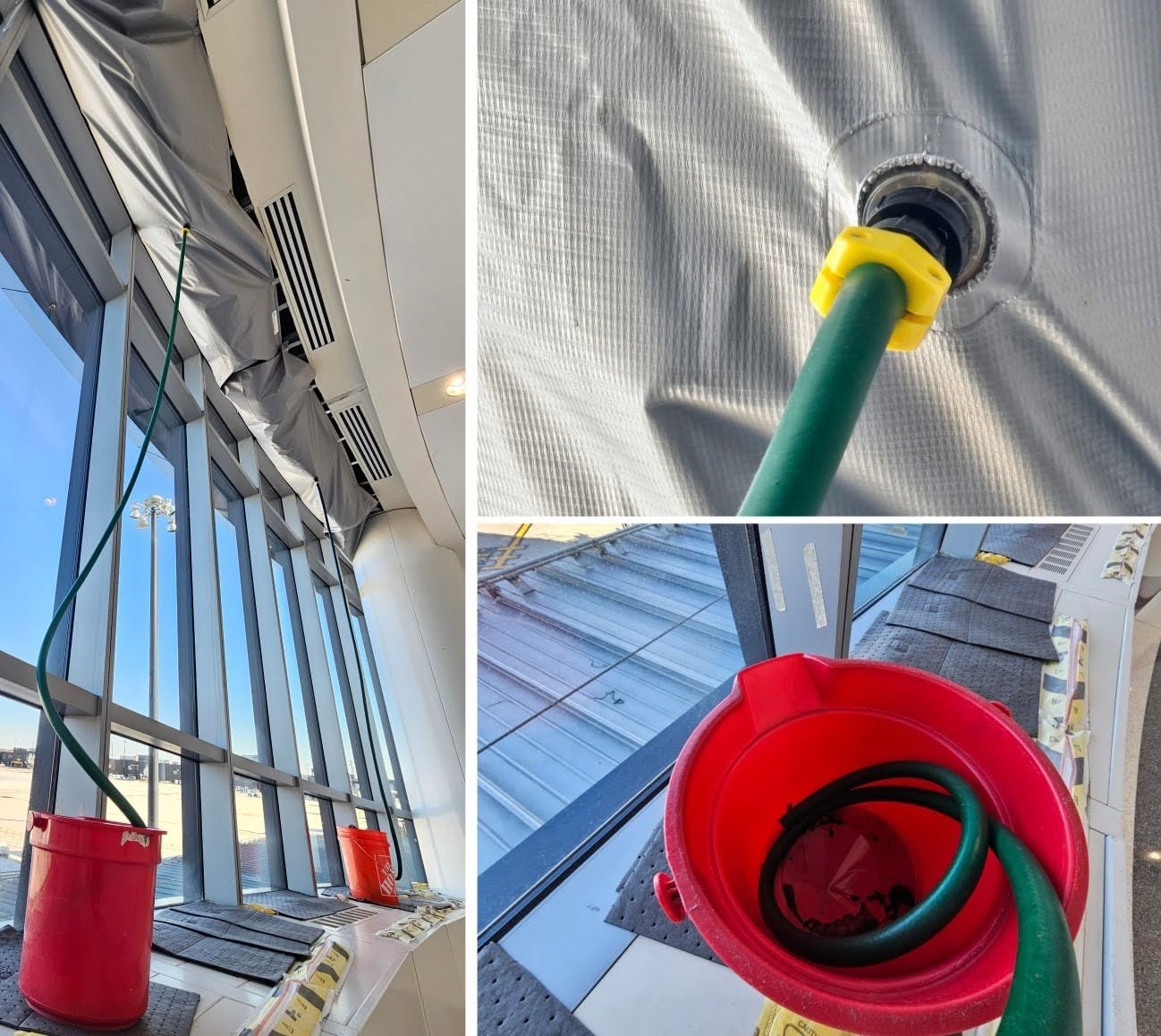
In the picture below you can see an example of a particular type of leak collection system that can isolate leak areas and collect the water. The particular purpose or benefit of this type of system is that in addition to collecting the water, it’s set up with a relatively little footprint so the rest of the interior space continues working in operation. Obviously, as you can see in the pictures below, this happens to be at a commercial industrial location where the space needs to continue being used in operations.
Some spaces have a very high cost of down time. Down time, essentially the opposite of uptime is when the space is shut down. In this particular usage, the term uptime refers to the time in which the space is continuing in operation without interruption.
In some cases, even with just simple roofing systems, water testing may involve multiple iterations of extended periods of hydration. In other words, water may need to be applied for several hours or days just to fully get the substrate area wet. Particularly where there are interstitial building materials, those building materials in between the membrane and the ceiling below may need to reach the point of complete wetness or hydration that they become fully saturated. Before the point of complete saturation, they might not actually leak over into the ceiling space below.
A quintessential example of this type of scenario will be insulation. There are multiple types of insulation, but one of the most common is fiberglass batt insulation. In some cases, that installation will need to be fully soaked to the point that it cannot hold any more water. The insulation itself has characteristics similar to a sponge.
It will keep absorbing water, drop by drop. Once it reaches the full saturation point, every next drop will then pour over and will then go to the next material below. In most typical Washington DC ceiling installations, this ceiling will be covered or sheathed with half inch or 5/8 inch gypsum wall board. In commercial configurations and assemblies, the drywall might actually be three quarters inch of thickness just so that it has a higher fire rating as required by the particular design and or authority having jurisdiction.
Once the roof leaks so badly that it fully hydrates or saturates the insulation below, the same process of hydration and saturation then needs to happen for the drywall. Once that drywall becomes fully saturated, and or compromised to the point that water will permeate through the drywall, then and only then, the leak will show up in the ceiling below. People generally only recognize the leakage once they can see it at the exposed ceiling.
The picture below shows a leak containment system, installed at the ceiling, where the leak is originating, just above.
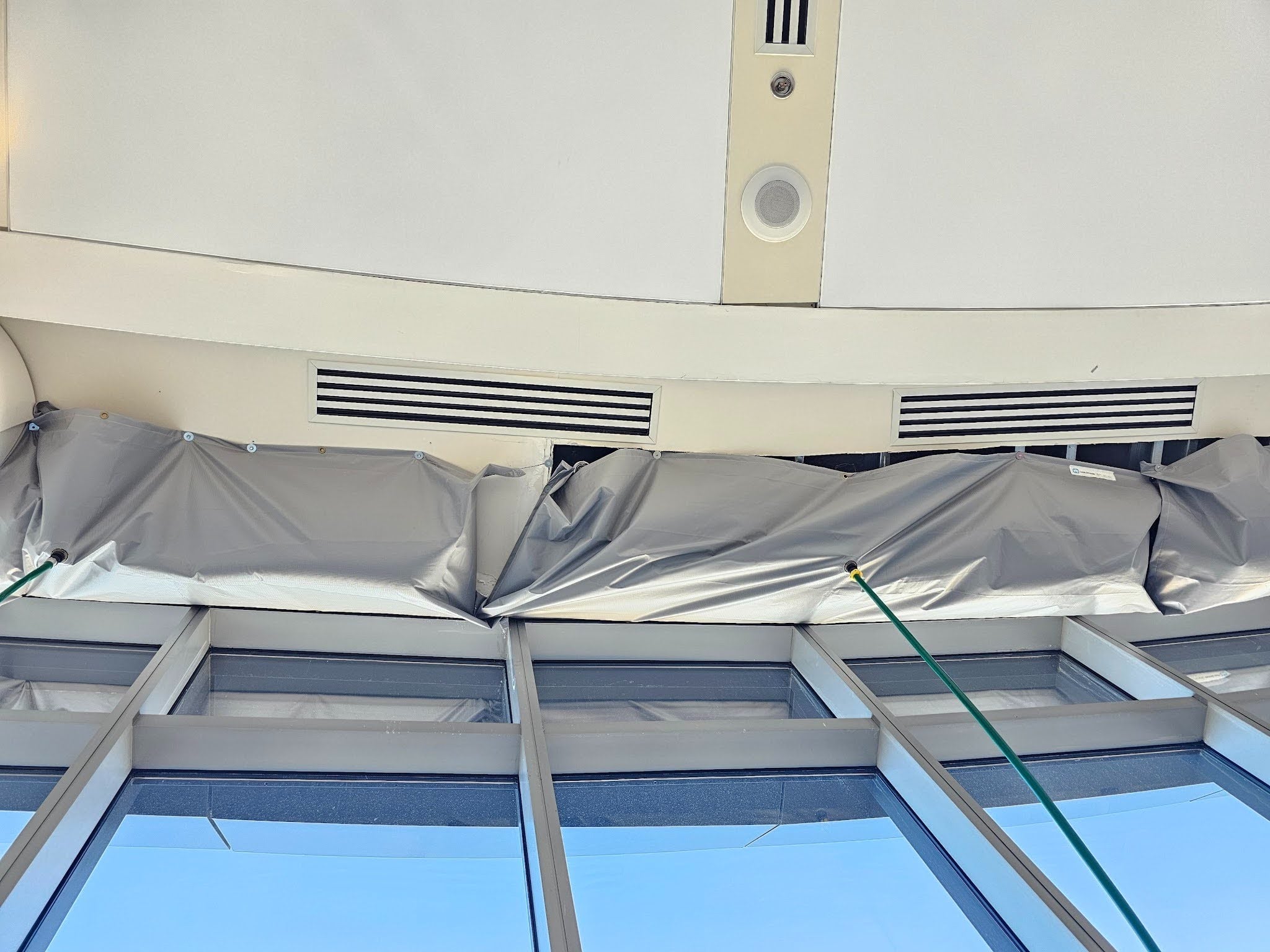
In this coming week, we’ll look at other pictures of different elements of this system.
We provide this information here on our blog, and our website, to help our customers and future clients, and we recommend every building owner in DC who values the longevity of their roof (and their investments) and building use a contractor who values the simple and important principles of proper roof construction like Dupont Roofing DC. Our company specializes in flat roofing here in Washington DC and we’re happy to help building owners of almost all types.
Learn more about our company and the proper techniques of working with roofing on historic buildings in Washington DC here on our blog at DupontRoofingDC.com, and you can call us at (202) 840-8698 and email us at dupontroofingdc@gmail.com. We are happy to help and at least talk through options.