Skylight Leak Rebuild and Replacement in DC
There’s a lot of old skylights out there across the rooftops throughout Washington DC. Some of them are antiquated. Some of them are so historic, they’re as old as the buildings themselves. Many of those antiquated historic skylights have ferrous metal frames and fire glass. You can pretty quickly identify and visually distinguish fire glass from more modern types of glass because the fire glass will have a reinforcing wire that is built right into the plane of glass itself. Sometimes, once these old skylights start leaking they can be repaired, but often it just makes more sense to replace them.
Ferrous metal frames are also generally pretty easy to recognize because they’re either painted and or rusty. They can sometimes be both. It’s some cases the rusty frame will have paint on it, but the paint will be largely or partially delaminated and peeling off. Underneath the areas where the paint is peeling away there’s generally a bit (or a lot) of rusty metal exposed.
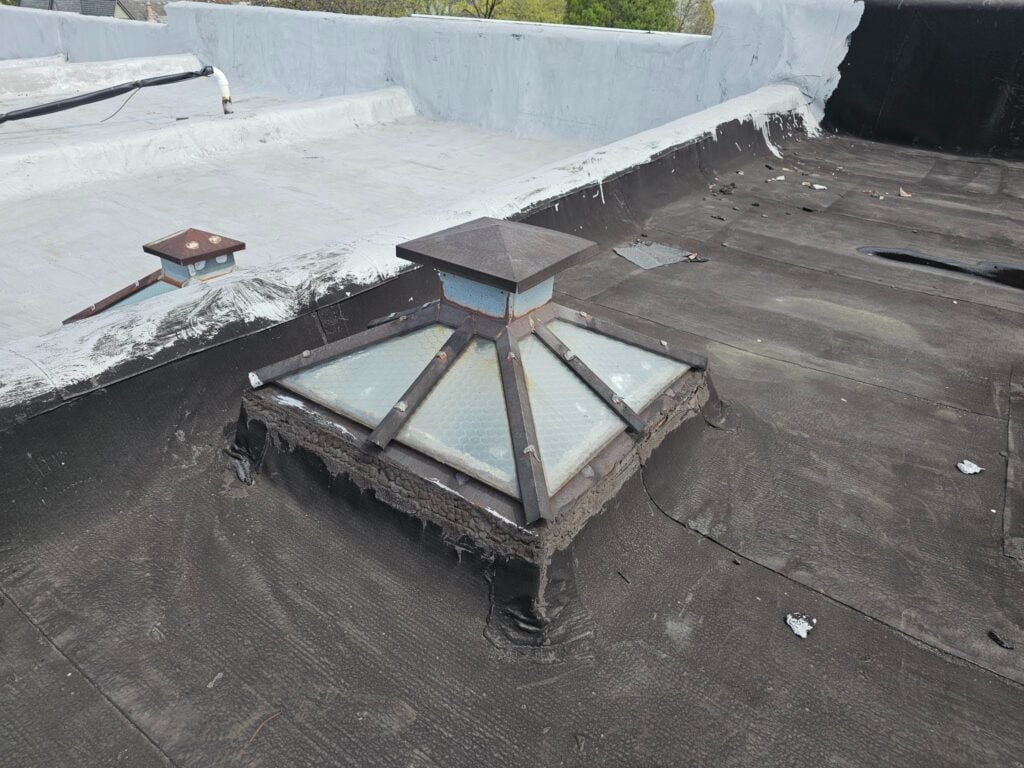
In this particular case, in this particular example, we aren’t really suggesting that this skylight be repaired nor that this roof is in an acceptable condition. Without replacement though, you are just essentially spending money to postpone the inevitable. You aren’t even postponing it very long. Here in this particular example, the roof is in bad shape and the skylight is also in terrible shape. So in this actual example, we would recommend replacement of these elements.
There are many other cases though where repairs actually do make sense. Understanding the difference is important. Wholesale replacement is often way more expensive m, yet it is often way more affordable in the big picture. In fact, although we mentioned potentials for repair, this is a quintessential example of when it makes more long-term sense to replace the roof and the skylight. We will look closely at the details and show why.
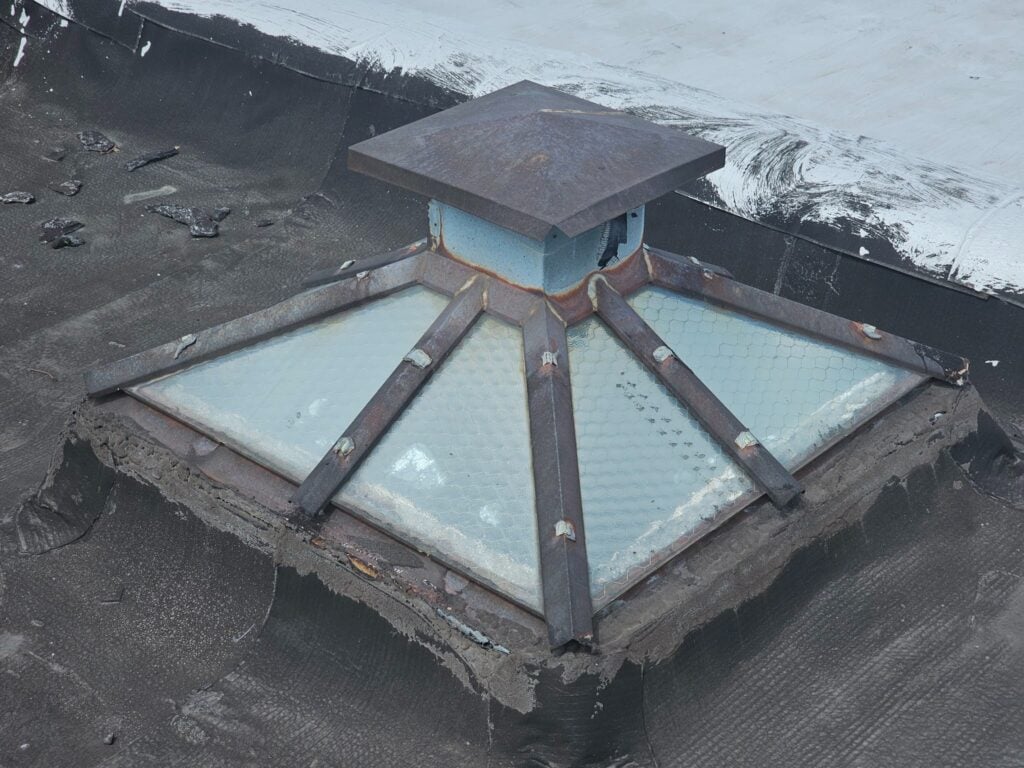
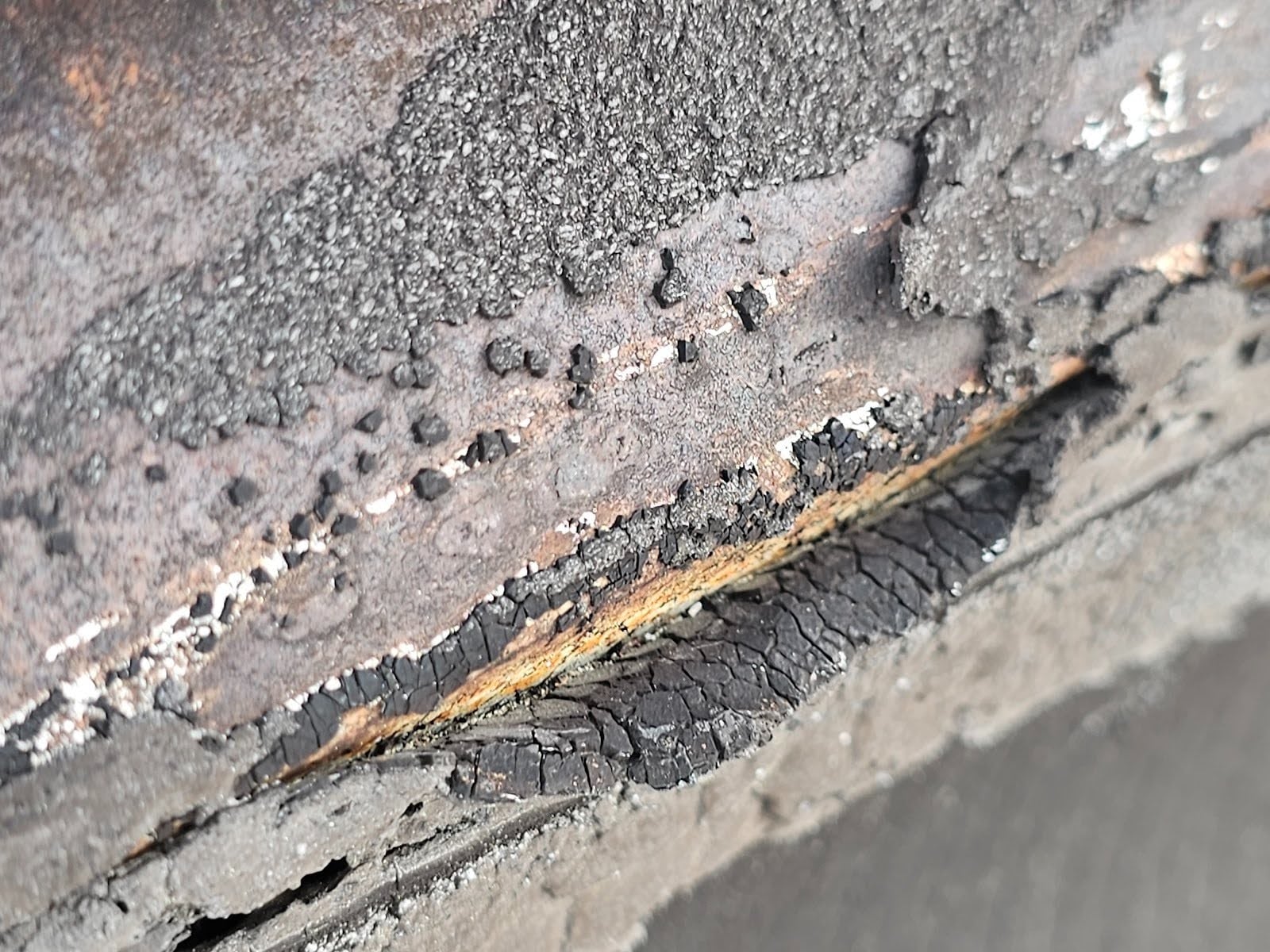
When you look closer to the outer border of the skylight, you start to get a sense of the condition. This skylight has been repaired in the past. It’s covered with caked on layers of asphaltic mastic. That asphaltic mastic, by itself, lacks an intrinsic mechanism to resist ultraviolet. Ultraviolet is the slow destroyer of most roofing materials.
Some of the new roof systems such as TPO, have a high level of intrinsic defense against exposure to ultraviolet. Even the best materials, though, will eventually break down just from exposure to the elements. There are many good roofing materials that have significant levels of durability. With all of our modern advances in technology though, there are very few materials that come in a bucket, and can be applied in a liquid or even low viscosity form that can really withstand ultraviolet.
This asphaltic mastic works well in quick repair type scenarios. That’s important if there’s a leak or emergency that needs to be fixed in the middle of an episode of rainfall. So even though these materials shown here in the pictures do not work well, they have a purpose. There’s some good reason why they’re still being sold. The problem is many people who are willing to be hired to do roof work are not actually professional roofers. Sometimes those non-professionals just don’t understand the difference between the different types of materials available on the market. Another one of the problems that contributes to the confusion is that these asphaltic materials are sold at the big box stores.
The better materials that should actually be used for low slope roofing are sold through specialty industrial suppliers. Not that long ago, here in Washington DC, most contractors tried to do things cheap and they just used the regular cheap materials at the hardware stores and the big box stores instead of going to the professional industrial suppliers.
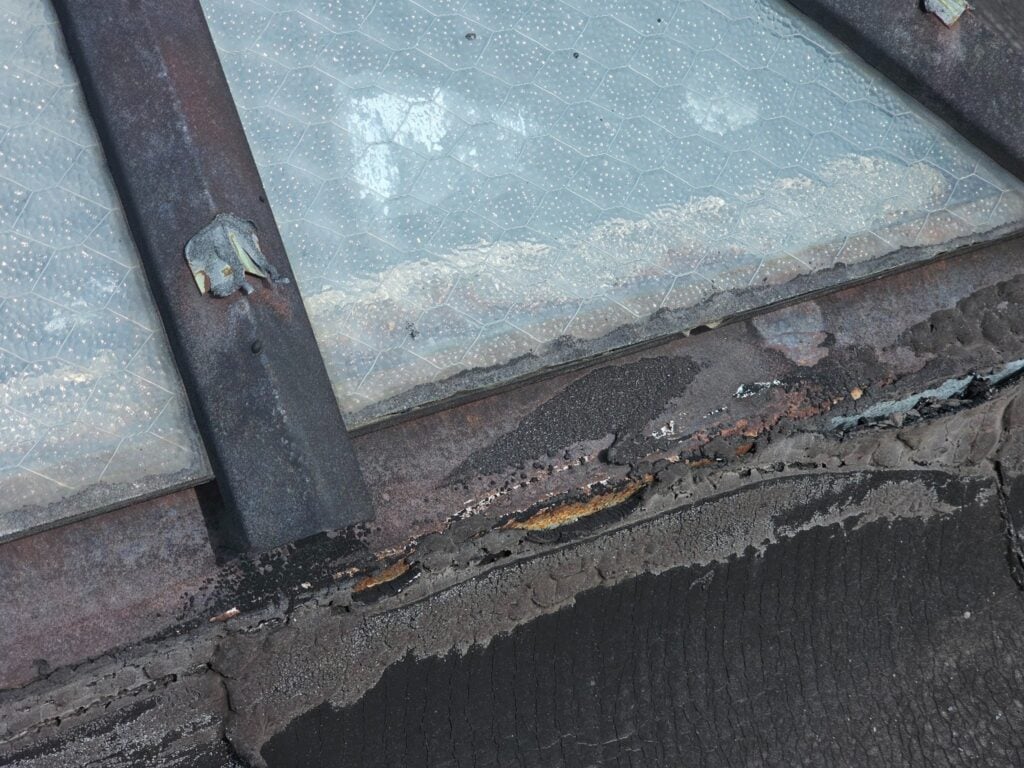
In this coming week, we’ll look at other examples of the deterioration around the perimeter of this skylight and talk about options for new roofing and taller curbs. We haven’t yet discussed the curb at the perimeter of the skylight, but here the skylight sits just above the horizontal surface of the roof. Many of the historic installations were done in a similar way.
Instead of building taller curbs, they just installed the skylights a bit above the roof membrane itself. That doesn’t work nearly as well as building the skylight on top of a curb. Also, today, the building code requires curbs in our climate zone so that things like skylights sit above the typical snow load heights.
We provide this information here on our blog, and our website, to help our customers and future clients, and we recommend every building owner in DC who values the longevity of their roof (and their investments) and building use a contractor who values the simple and important principles of proper roof construction like Dupont Roofing DC.
Our company specializes in flat roofing here in Washington DC and we’re happy to help building owners of almost all types.
Learn more about our company and the proper techniques of working with roofing on historic buildings in Washington DC here on our blog at DupontRoofingDC.com, and you can call us at (202) 840-8698 and email us at dupontroofingdc@gmail.com. We are happy to help and at least talk through options.