Roof HVAC and Duct Flashing Problems: Understanding Condensation Issues
This past week, we talked about three distinct reasons why HVAC systems and mechanical equipment on rooftops can lead to problems related to leakage and accelerated deterioration. Today, we’re also going to talk about a fourth reason which is that ducts can create condensation. Condensation is actually the accumulation of water molecules on material surfaces or in vapor in the presence of significant temperature differentials. That type of temperature differential is actually common.
Colder areas or surfaces can attract or create the accumulation of moisture in the form of water droplets. As water droplets accumulate, they turn to water drops and as those drops then next accumulate in streams of water that will run through the ductwork and down into the building.
As a mechanical system and or ductwork is supplying air to the building, air flows in a way that is similar to the movement of a liquid. As that air flows it also allows the water to move flow as well. That water comes down through the ductwork into the building.
There, the water will damage drywall finishes, plaster, wall partitions and even flooring. Often, the exterior ducts may have a higher amount of sealant applied than the inner duct joints and as the water enters into the interior portions of the ductwork, instead of reaching the termination or outlet of the duct system, the water may instead leak through the individual joints in the many pieces of the duct.
The picture below shows a duct at the exterior, above the rooftop. The joints of this location have been treated with Materials that are intended to keep it waterproof of full stop At the interior, you would normally expect to see the HVAC contractor using a mastic that is intended to seal from an air flow perspective, but not from a waterproofing perspective.
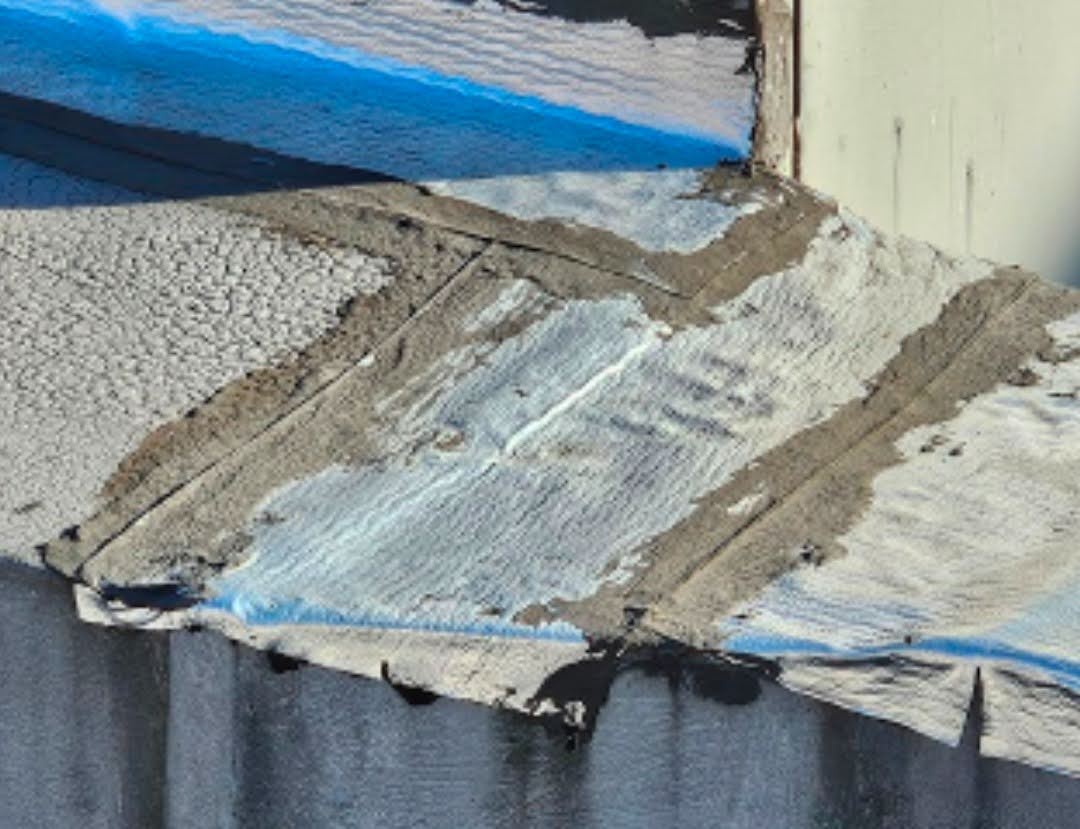
We take a look at one of these types of issues in the pictures below. In the ductwork below, you can see that there is a joint near the main run of the duct is a transition duct. A liberal, sloppy amount of sealant has been applied at the connection from the transition to the rooftop mechanical unit and between the transition and the continuing duct run. A shiny metal tape has been applied along the seams but then an additional asphaltic type application has been applied on each side of the tape.
There may have concerns during the main upkeep of the roof that water was entering underneath of the tape. All of these installed elements are only as good as their transitions. Generally the highest concentration of problems or maintenance issues with deterioration or defects happens at the edges of transitions and terminations. Another type of common problem area in rooftops is with foreign non-roof elements and at penetrations are or at where those elements penetrate through the roof.
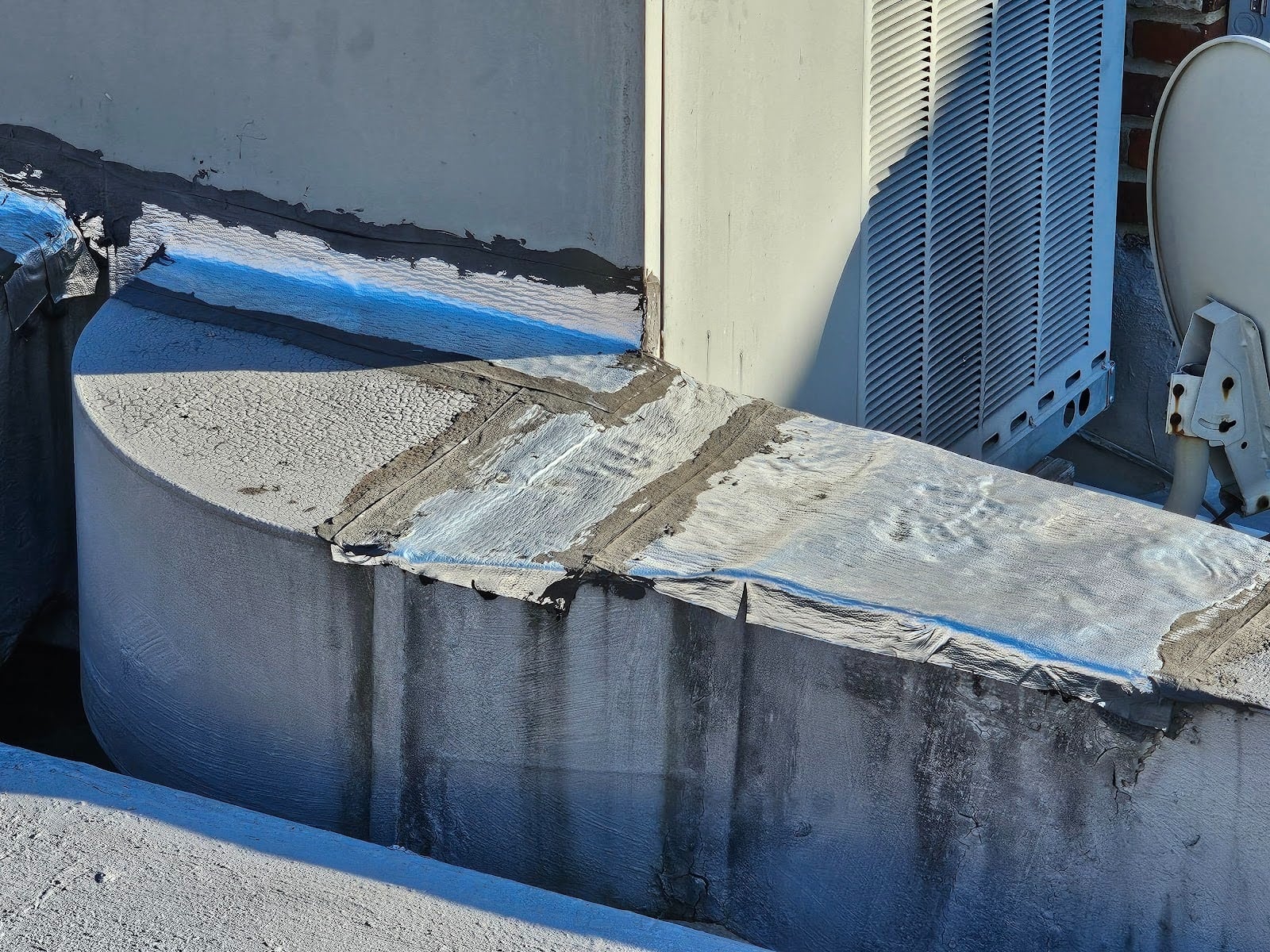
Part of this application is a bit better than just typical duct mastic. There’s no question about that. Duct mastic because brittle and has very low resistance to exposure to ultraviolet rays. Those type of ultraviolet rays are present in everyday sunlight. This UV will deteriorate typical duct mastic very rapidly. In addition, on the interior of the building where duct mastic is required in typical duct joints it is protected from the exterior elements.
It doesn’t work as well on the exterior of the building though, because the ducts experience more thermal movement and deterioration. On the exterior of the building where exposed to the full range of environment to weather conditions, the mastic will be quickly destroyed. This type of thermal movement applies to all types of roof elements including the sheet metal used as roof copings or terminations and transitions. Metal and all materials will shrink and expand a bit as thermal changes are imposed upon them.
Metal moves significantly more than some other types of typical building materials. Masonry, for example, will also move when exposed to significant thermal changes, but the amount of contraction or expansion is small compared to the amount by which metal will move. Sheet metal is elongated and very thin and will experience some of the highest amounts of expansion and contraction.
Your physical reality isn’t necessarily a problem, but where materials are brittle or rigid and lack compatible amounts of flexibility, it may cause fracture and breakage of the more rigid materials. For example, in the case of this ductwork, as the ductwork moves during conditions of changing thermal temperatures, the interior type of duct mastic, only intended for use inside of buildings, but often mistakenly used in expertior joints, will have a tendency to eventually breakdown and or deteriorate.
Here, instead of typical duct mastic, they have used more flexible materials. Those materials are better but also lack significant resistance to ultraviolet exposure. The black asphaltic materials are some of the worst performing elements for resisting the deleterious effects of exposure to ultraviolet. Typically, the asphaltic mastics are marketed and sold as wet patch type materials which can offer a terrific solution when wet patches are needed. During rain storms or high precipitation events, when an emergency patch is needed, they can be great solutions when applied properly. They don’t last though, when exposed to sunlight, the sunlight breaks them down and makes the material quickly.
In this coming week we’ll talk more about the issue of condensation and interior rot related to condensation running through ductwork.
We provide this information here on our blog, and our website, to help our customers and future clients, and we recommend every building owner in DC who values the longevity of their roof (and their investments) and building use a contractor who values the simple and important principles of proper roof construction like Dupont Roofing DC.
Our company specializes in flat roofing here in Washington DC and we’re happy to help building owners of almost all types. Learn more about our company and the proper techniques of working with roofing on historic buildings in Washington DC here on our blog at DupontRoofingDC.com, and you can call us at (202) 840-8698 and email us at dupontroofingdc@gmail.com. We are happy to help and at least talk through options.