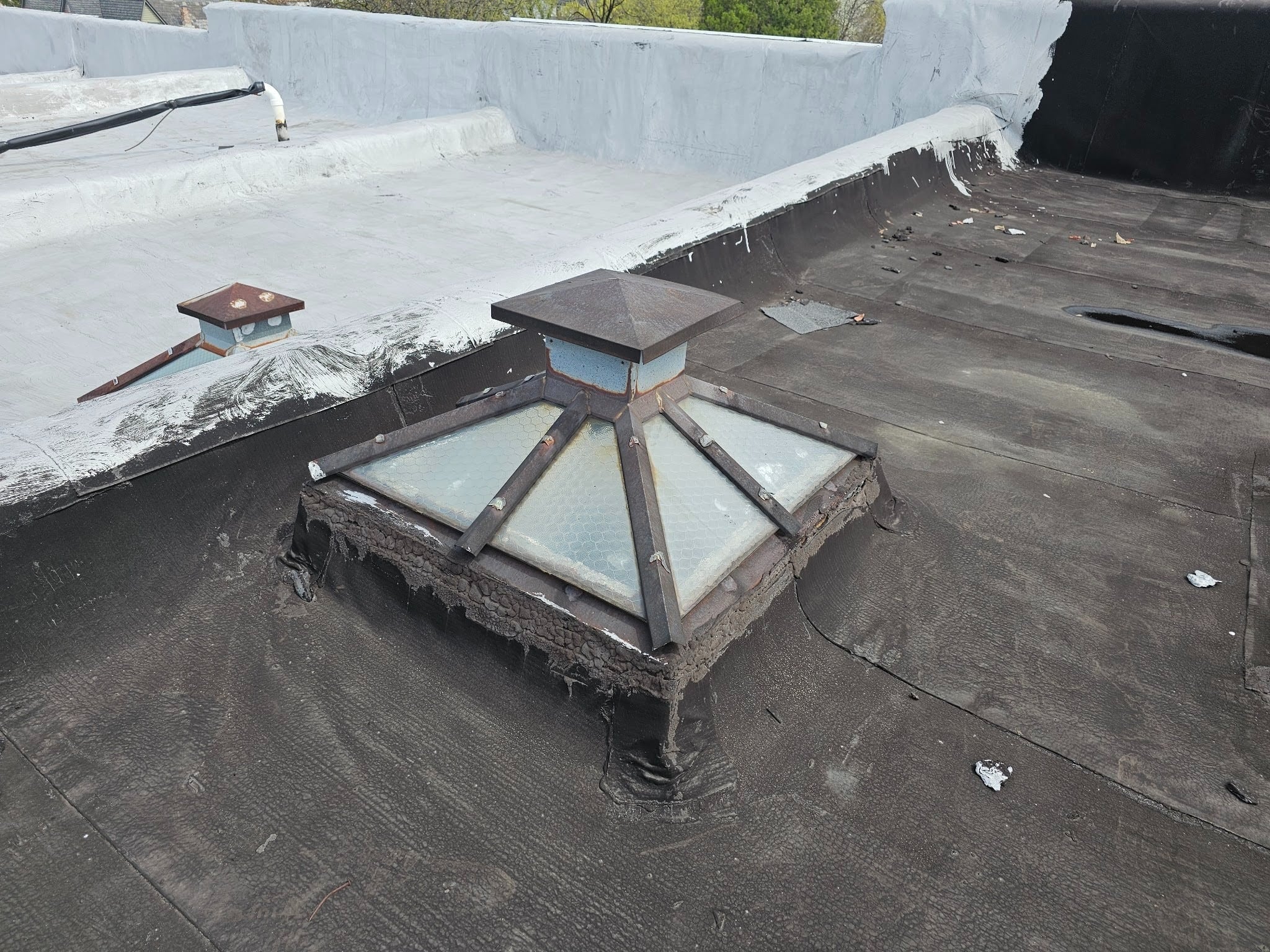
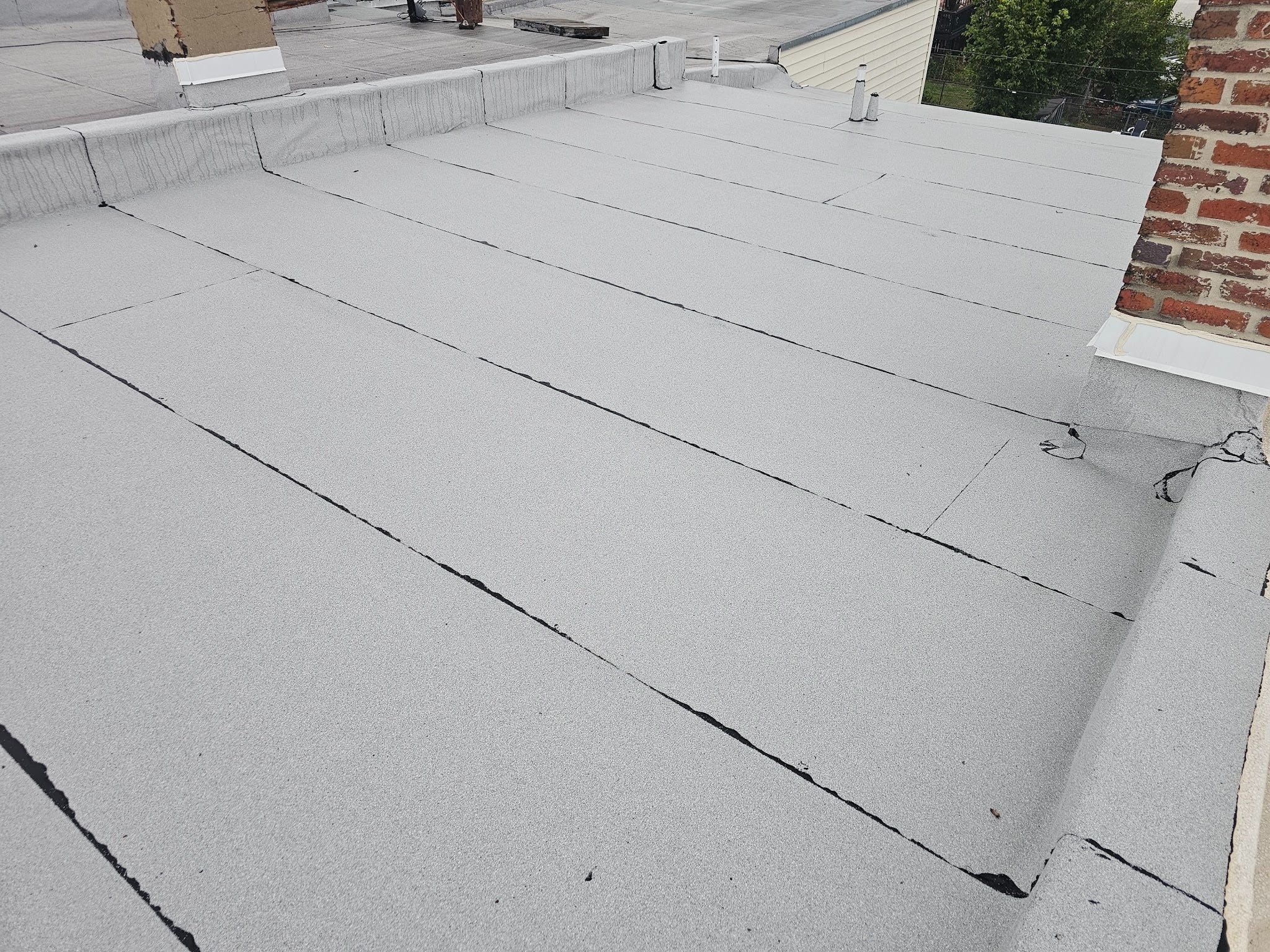
This past week we looked at duct joints on the exterior of rooftops where the sun is literally causing those joints to deteriorate and break apart. The UV exposure will make the materials fail at a highly accelerated rate. In the absence of sunlight and with moderate exposure to excessive temperature fluctuations, the same materials could last for many years. The reality though, on rooftops, is that they’re in a location, most often, where they have no shelter or refuge from intense sunlight every single day.
We also mention the topic of condensation. When it’s freezing cold and hot air is moving from a totalpak type, all-in-one unit on a rooftop, which does both heat in the winter and cooling in the summer, it can cause significant condensation. We mentioned last week that that condensation can then run through the ductwork and drain or run all the way into the interior of the building causing rot from moisture on the interior.
In most cases, when HVAC work is done properly, in modern times, the dicts will have an interior lining. That ductwork is generally manufactured with a half inch black insulative lining on the inside of the duct. You don’t see it and the fact that it’s on the inside instead of the exterior helps protect the insulation from the same type of rot or deterioration from UV exposure that breaks apart the mastics at the duct joints on a rooftop.
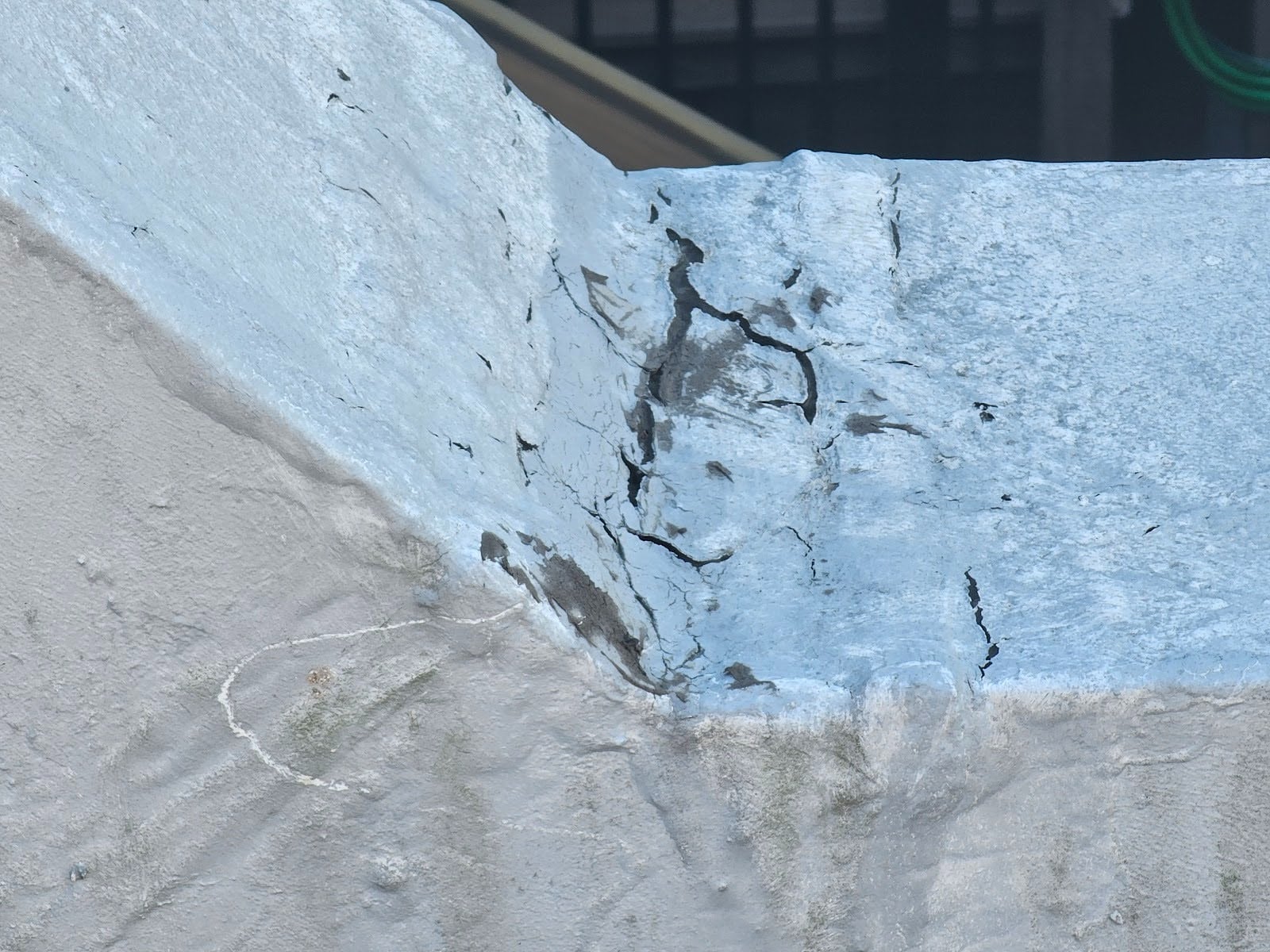
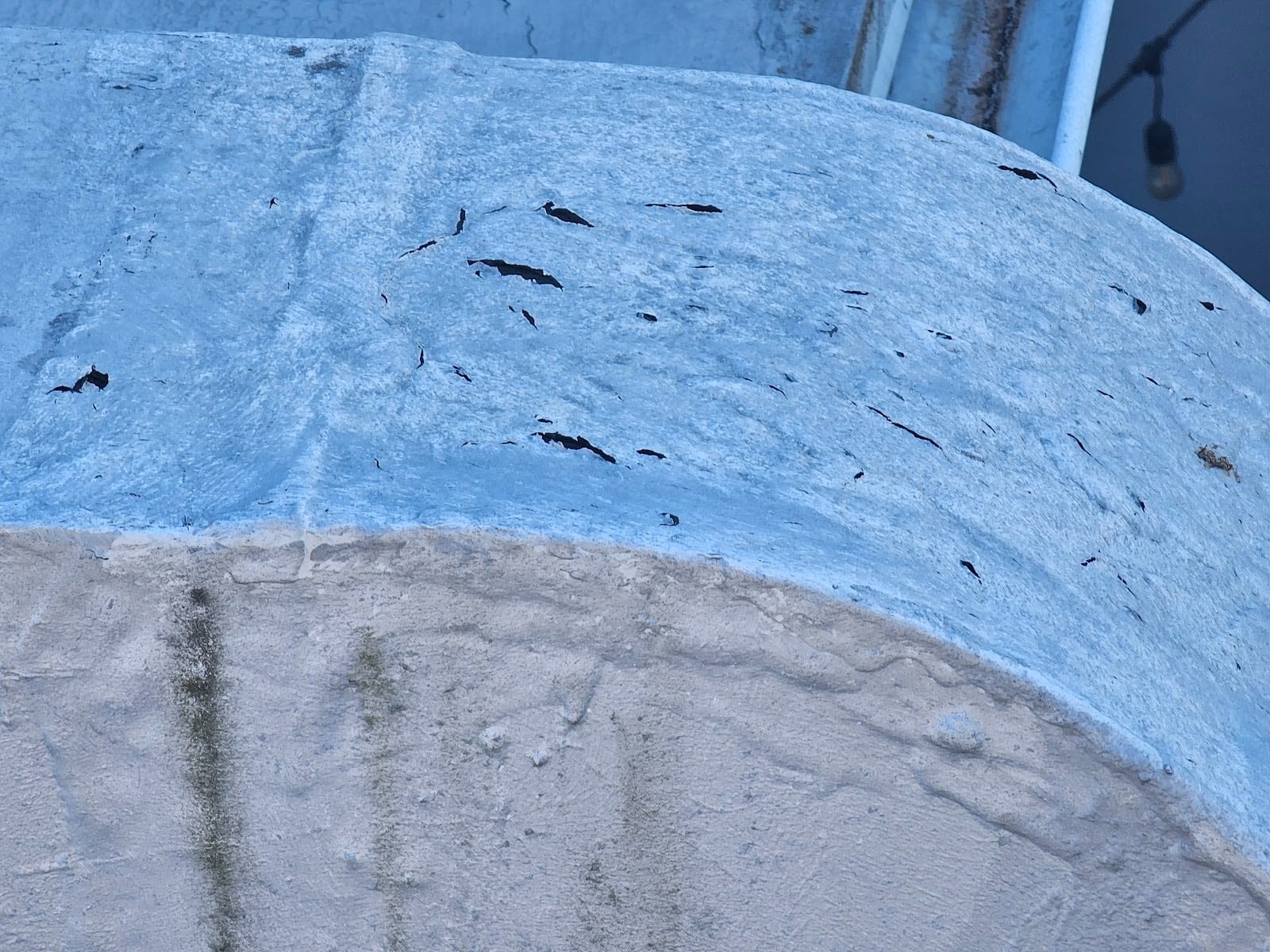
If you look closely at the surface of the ductwork shown in the picture below, you can see that the coatings on the exterior top of the duct are deteriorating and flaking. Those coatings are intended to protect the substrate sheet metal which forms the structure of the duct.
We talked about a handful of different problems that ductwork causes on a roof. One of the other big problems is that the ductwork itself, made of sheet metal, is not entirely different from the sheet metal used for roof terminations and roof copings. The metal used to constitute the ductwork itself may be of similar gauge and thickness. There’s a big difference though. The sheet metal used to make duct work is generally made from ferrous materials. There are exceptions. For example, in grease ducts used in commercial kitchens, the ductwork will be made from a much more expensive stainless steel.
There are even cases where aluminum ducts will be used. Generally though in copings and dheet metals used in roofing, aluminum will be used. The aluminum may be of similar gauge or thickness. It performs much better than the ferrous metals. The aluminum lasts much longer in an exterior type application like that. Ferrous metal ductwork, itself, really shouldn’t be used for most applications where exposed to exterior elements.
The particular location below is doubly problematic because it’s at a place where water will pond. Essentially, there is a slight depression in the top of the ductwork at the transition or joint that changes the angle to run the ductwork upwards. At that face of the transition, the slight concave shape allows water to sit there longer than it should.
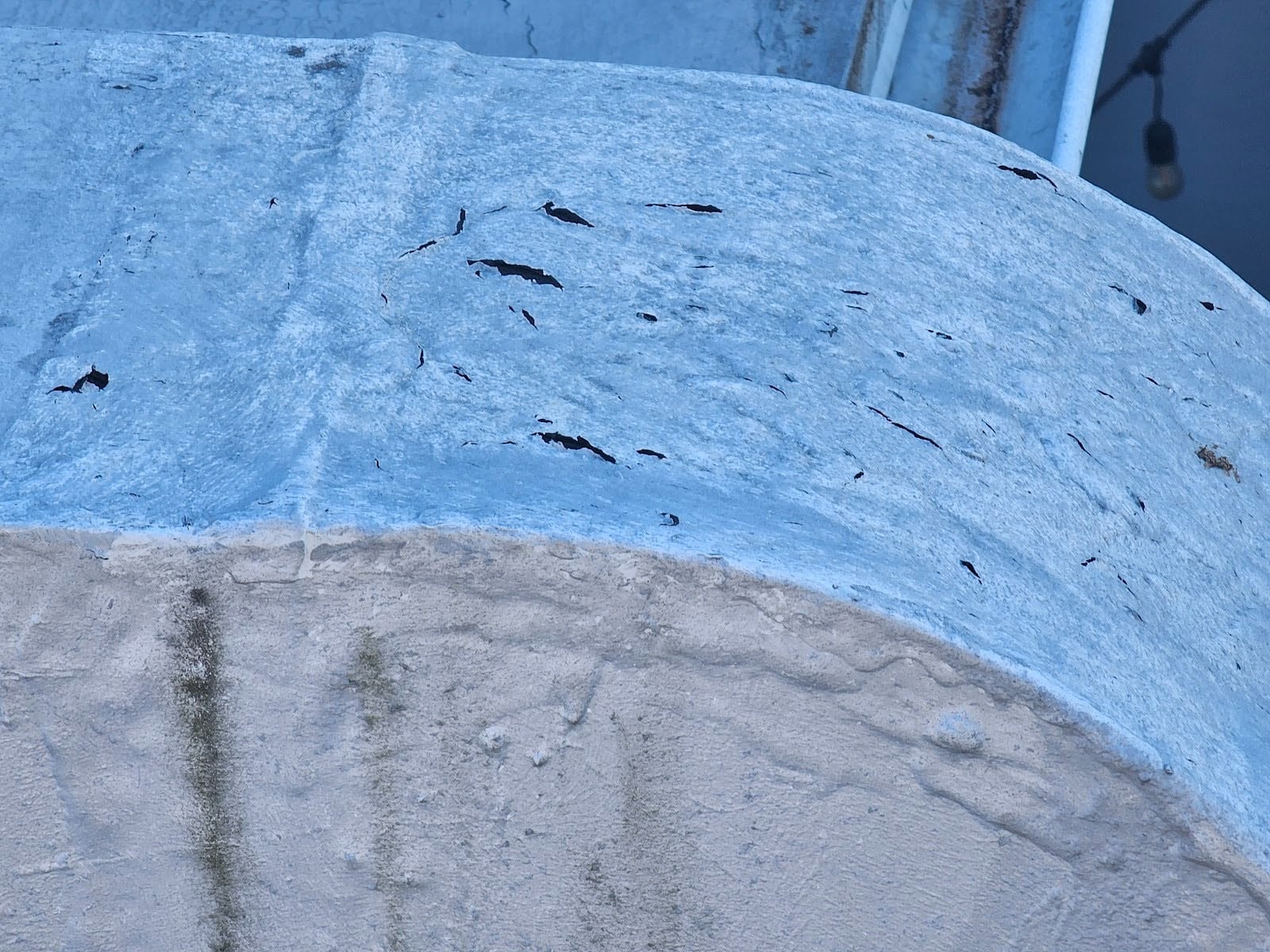
Here, in the picture below, a continuous sloping convex elbow transitions downwards. This is a little bit better than the conditions shown in the picture above, but it’s still problematic because of the nature of the materials of the ductwork sheet metal and the coatings. The problem here isn’t an issue of incompatibility. The problem is about the original material choice of the electro galvanized sheet metal. Since that metal is a ferrous alloy, it will deteriorate at an accelerated rate, especially where coincident with static water buildup and ponding
You can see they’ve attempted to apply multiple layers of coatings on top of this ponding area, but even those coatings have limited lifespans. Now, the problem with those coatings is that since they are not themselves a roll roof membrane or even a fluid applied type membrane, they break down and need reapplication. Since they are partially delaminated, it’s much more problematic.
The partial delamination allows for water to enter in underneath of the area between the interstitial space that is in the middle between the ductwork and the failing coatings. Once that water enters, it only evaporates slowly. During the excess time that it’s been trapped in that interstitial space, it will cause accelerated deterioration or oxidation to the ductwork which breaks it down and makes it fall apart. Deterioration at sheet metal like that starts with pin holding but later leads to full scale decomposition.
As water enters in through those holes and areas of decomposition, it will run through the ductworks and eventually make its way into the building causing leakage.
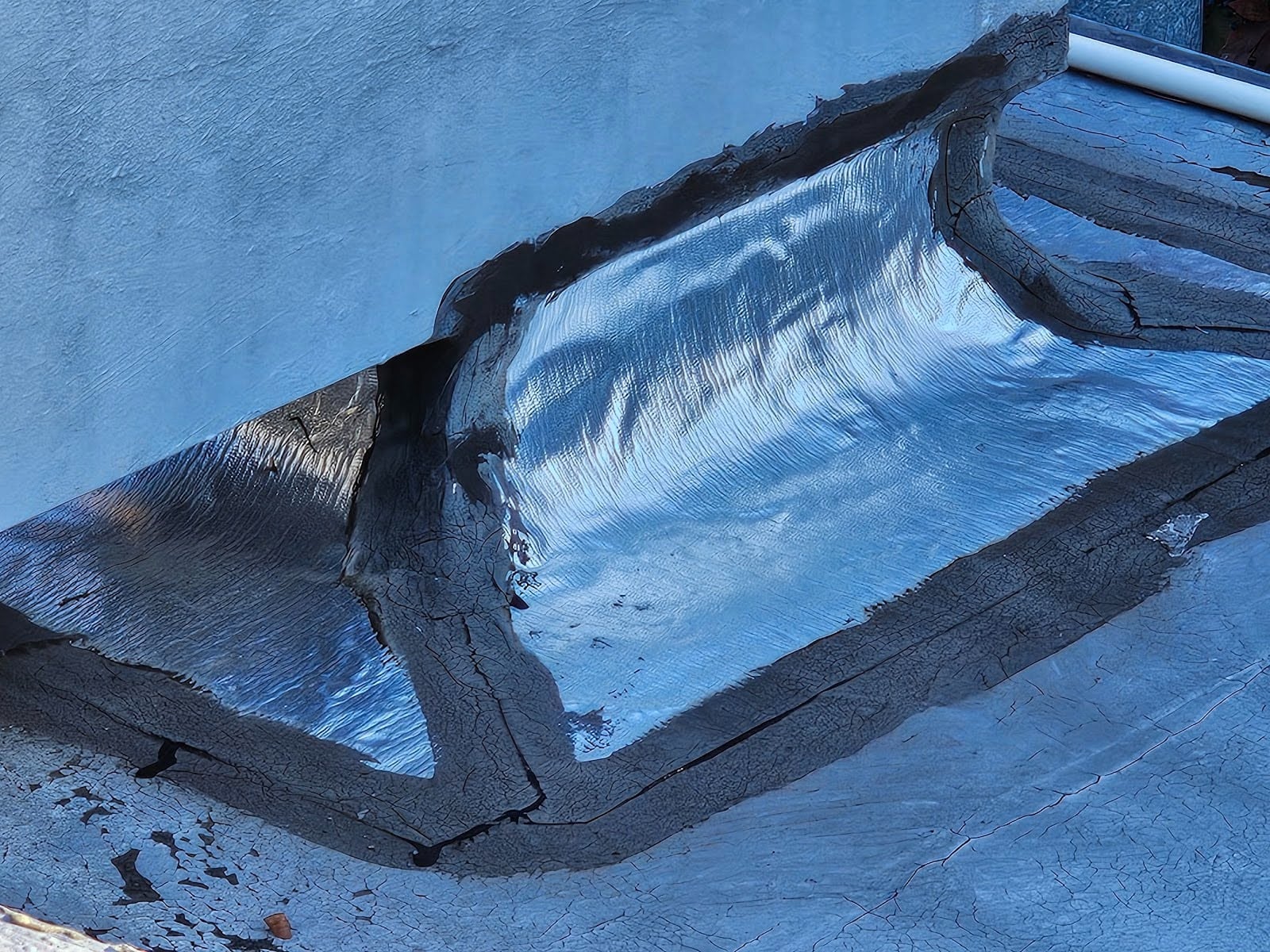
Even though we’ve been focusing on talking about some of the problems with transitions from ductwork to ductwork, in the continuous runs, there are also significant problems where the ducts transition to the termination. We mentioned some of these issues in the first part in this series. The picture below shows an example where counter flashing was installed on top of a roof base flashing.
It is turned up to run around the ductwork. This type of application is correct in many ways, but there are still some defects. The asphaltic black mastic applied around the top of the counter flashing may be installed just as a redundant means of extra protection, but it will deteriorate and create an open area at an interspicial space where water can be trapped. That water then will deteriorate the substrate metal in an accelerated timeline.
A different type of application has been applied at the base of the duct, at a downward penetration through the roof membrane. Here, instead of using a base flashing and counter flashing combination, they have wrapped the entirety of it with an overlay of roll membrane. The roll membrane, here though, has lapping joints at each corner instead of running continuously. The shape of the termination or transition at the penetration flanges are flayed outward in a way that makes it difficult to be wrapped with a single continuous piece of membrane. Instead, individual pieces of flashing overlay have been applied on each side of the square duct base.
Since there are joints at each of the corners, it’s created a configuration where there are additional joints than optimal. Each of those joints must be traded like an individual area of termination. The solution they’ve used here is to apply additional asphaltic mastic on top of each of the joints but that is a short-sighted and ineffective as a long-term solution because the asphaltic mastic will not last or withstand exterior exposure.
We provide this information here on our blog, and our website, to help our customers and future clients, and we recommend every building owner in DC who values the longevity of their roof (and their investments) and building use a contractor who values the simple and important principles of proper roof construction like Dupont Roofing DC.
Our company specializes in flat roofing here in Washington DC and we’re happy to help building owners of almost all types. Learn more about our company and the proper techniques of working with roofing on historic buildings in Washington DC here on our blog at DupontRoofingDC.com, and you can call us at (202) 840-8698 and email us at dupontroofingdc@gmail.com. We are happy to help and at least talk through options.