Colonial Revival Architecture: Gable Roofs with Dormers
This past weekend we started looking at a particular building, from an architectural perspective. This building is a little bit different than the typical things we see here in Washington DC, on a daily basis. There are some overlaps in the architectural elements though. Those overlaps happen in the suburbs within the city. It’s hard to think of the city having suburbs, but when you leave the downtown and downtown and adjacent areas, you depart from an area filled with historic row homes and before you actually get out of the city you start going into neighborhoods where there are free-standing homes, in some cases.
A lot of these expansive areas of freestanding homes are on the west side of the city. There’s also a few areas in the southeast side of the city where there are wide ranges of freestanding homes and neighborhoods built with a suburban feel. Here in the areas closer to downtown, wherever there are free standing homes, they have generally been split into multiple individual units or multiple apartments. In some of those cases, the original building exterior may remain similar to its original construction. In other words, it might be hard to distinguish many of these buildings from traditional single homes or buildings.
Often when you open the door though, you’ll find there’s a gang style mailbox with many small mailboxes inside of that battery and there will be many doors inside the common hallway which lead to individual apartments.
The particular building we’re looking at today isn’t in the city though, it’s way out in the country, far from the modern urban centers. Because it’s so remote, throughout its history it was never really impacted by the economics of urban density. Therefore, it was never split into multiple small units. It’s really nice to find a large old building that has been able to keep It’s historic original qualities.
The picture below shows a historic brick chimney built above the roof of this building. There’s an interesting terracotta flue which serves both as a duct for conveying the exhausts of a fireplace or boiler and also has an integral dome cap. The chimney isn’t necessarily part of the roof itself, but generally related to the roof, where it is built to penetrate through and above the roof.
If you look closely at the dormer roof sitting in front of that chimney, you may notice that there are shingles all the way up to the top of the ridge. Generally, we recommend a ridge cap in addition to running just bare shingles at the top of the ridge. The individual tiles of slate should be installed as shown, just capped. The problem with not having a continuous metal or similar impermeable flashing that covers the top of the ridge is that water can enter between the joints of the tiles at the top of the ridge.
In some cases, contractors will install caulking between the top point or pinnacle of the ridge, but that alone is not sufficient. Generally caulking will deteriorate on a time line much faster than the roof itself.
Installing a critical joining element that has a much shorter lifespan than the remainder of the roof creates a maintenance problem. It’s okay for people to install something and then plan on having to make adjustments or apply maintenance in the future. The problem though in reality Is that there isn’t always continuity between the installing team and the maintenance people. Without continuity, information such as inherent short timelines or longevity periods for important connecting materials like this may be lost. People like the maintenance crew may honestly just forget to keep a close eye on the accelerated deterioration of gun-applied sealants.
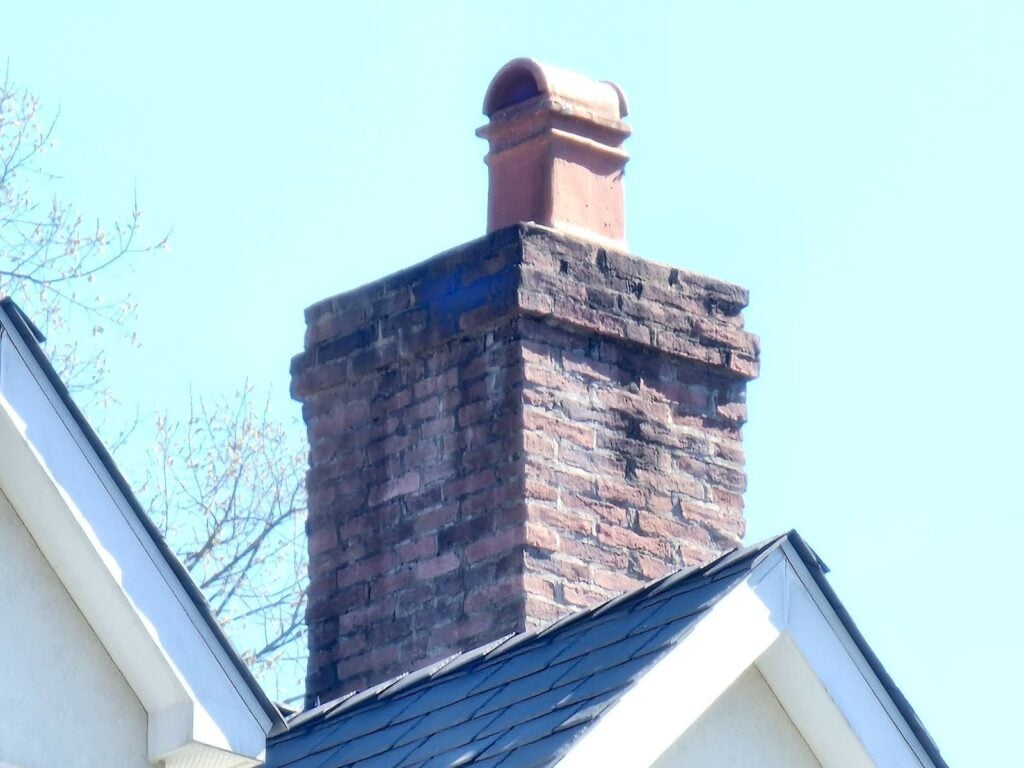
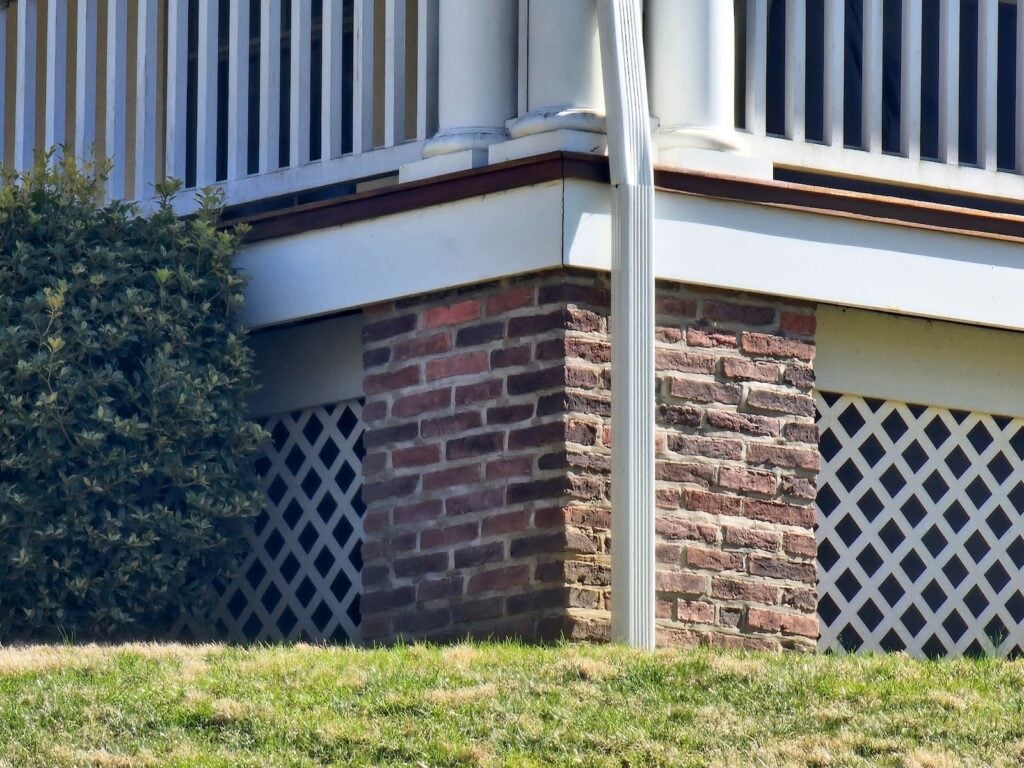
One of the reasons we know that the brick chimney was part of the original construction of the building is that it has the same brick used at the front porch foundation. That’s a pretty clear sign. Often we do chimney repointing, particularly where chimneys are installed above a rooftop. Sometimes those chimneys are in such bad shape because of exposure on all sides that we have to entirely rebuild those chimneys above the roof.
Particularly where there is just spot replacement of bricks and also a brick that is positioned in a prominent facade such as a location where it can be viewed side to side, we will often try to use a matching or similar looking brick. It’s not always easy to find a large number of bricks that are identical to the historic original brick of the building.
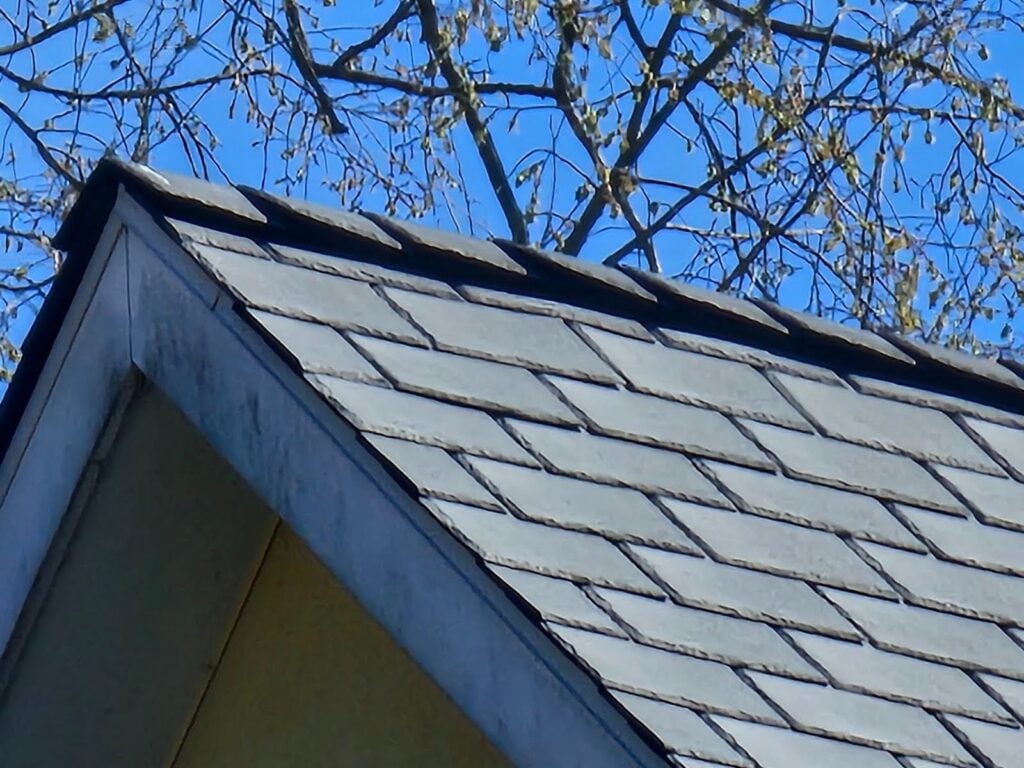
Here, you can see that instead of using a trim coil type sheet metal for the ridge capping, they used a synthetic slate material. You can tell it is synthetic slate because real authentic slate is not available in angled forms. Stone and natural materials of that type will not stay together in that type of connection. Even when glued with adhesives and chemicals, the materials become brittle at their fine edges.
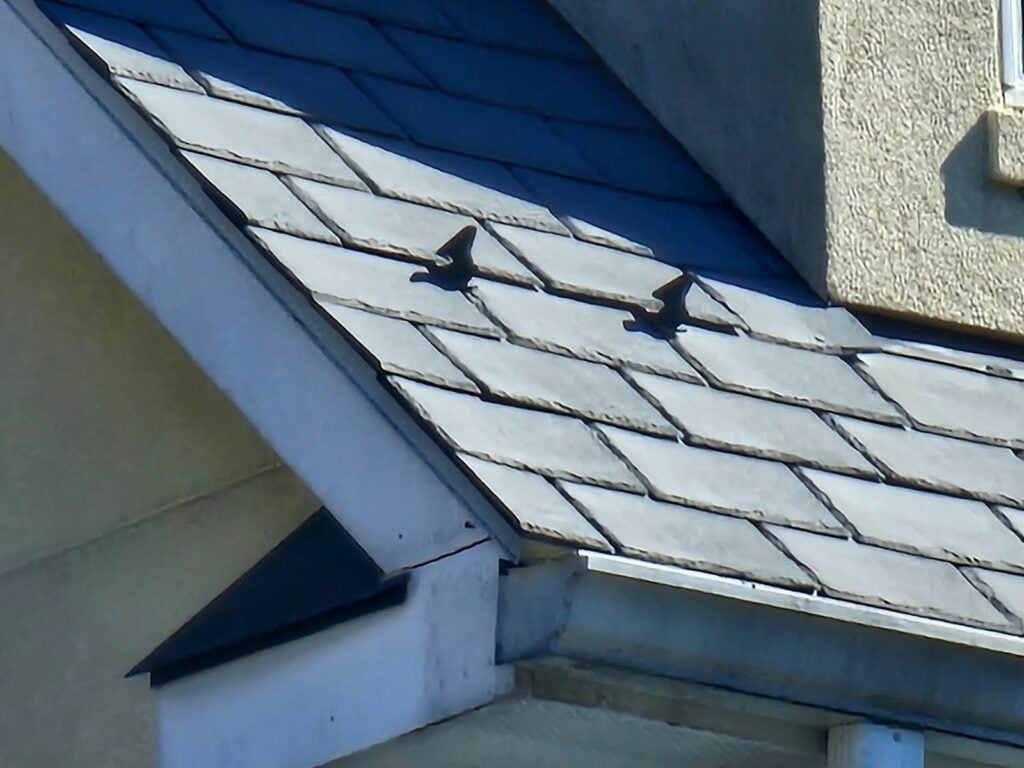
Ice guards or snow guards prevent big sheets of ice and snow build up from falling off the face of a roof all at once. If they do fall off all at once, they can come down with such force that it can literally crush a human and kill them.
We provide this information here on our blog, and our website, to help our customers and future clients, and we recommend every building owner in DC who values the longevity of their roof (and their investments) and building use a contractor who values the simple and important principles of proper roof construction like Dupont Roofing DC.
Our company specializes in flat roofing here in Washington DC and we’re happy to help building owners of almost all types. Learn more about our company and the proper techniques of working with roofing on historic buildings in Washington DC here on our blog at DupontRoofingDC.com, and you can call us at (202) 840-8698 and email us at dupontroofingdc@gmail.com. We are happy to help and at least talk through options.